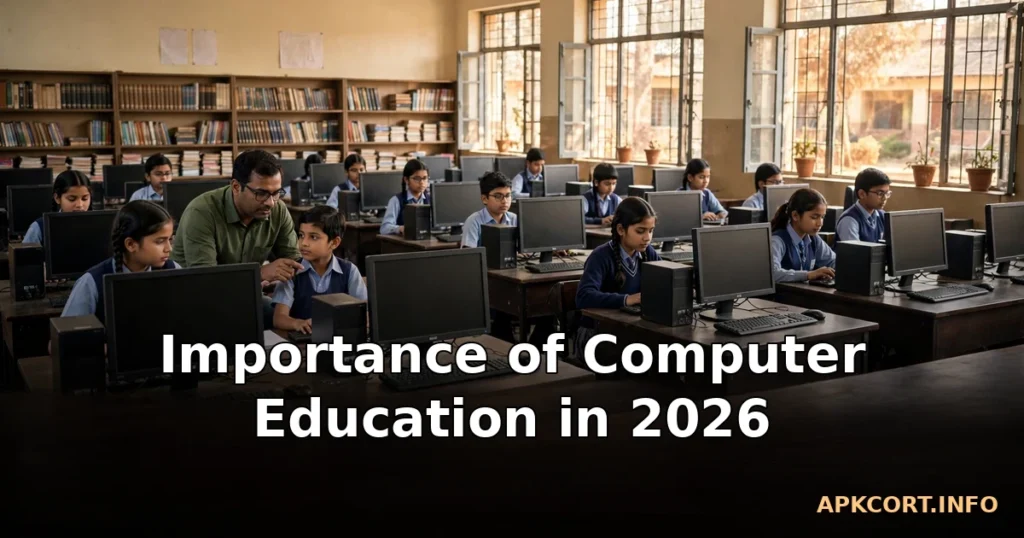
Last month, my cousin in Kanpur told me something that stuck with me. His 12-year-old daughter had to submit her school project online. He stared at the upload button like it was a puzzle from another planet, and his daughter, who had learned basic computer skills in school, finished the whole thing in ten minutes.
That small moment says everything about the importance of computer education in 2026. It's no longer a "nice extra" subject like drawing or music. It's the difference between participating in modern India and watching it happen from the outside.
Think about your own week. You probably paid someone through UPI, checked a train on IRCTC, or opened a government form that asked for an OTP. Every one of those moments assumed you knew how to use a computer. In 2026, that assumption covers nearly everything: jobs, school admissions, banking, farming subsidies, even ration cards.
What Computer Education Actually Means Today
Let's clear up a big misunderstanding first. When most people hear "computer education," they picture a classroom where kids type "A B C" on a keyboard and learn MS Word. That's maybe 5% of the story.
Real computer education in 2026 has three layers, and they matter in this order:
- Digital literacy: Can you actually use technology in daily life? Sending email, paying bills online, spotting a fake OTP scam, filling a government form on a portal, using DigiLocker to store your Aadhaar and mark sheets. This is survival-level stuff.
- Productivity skills: Can you use a computer to get work done? Spreadsheets for a small shop's accounts, presentations for college, video calls for a job interview, basic photo and video editing.
- Technical skills: Can you build with technology? Coding, data analysis, cybersecurity, AI tools. This is where the high-paying careers live.
A student who only learns layer one is still far better off than someone with zero computer knowledge. But the real life-changing money sits in layers two and three. Keep that in mind as we go.
If you're starting from zero, the natural first step is learning the basic computer skills every student should learn before anything fancy.
7 Reasons Computer Education Matters More in 2026
Honestly, I could write twenty reasons. But these seven are the ones that affect real Indian families, not just tech workers in Bengaluru.
1. Jobs now assume computer skills, even non-tech jobs. Walk into almost any job interview today, from a bank clerk post in Patna to a sales job in Surat, and you'll face a computer test or an online application. The days when only engineers needed computers are long gone. Receptionists use booking software. Shopkeepers use billing apps. Farmers check mandi prices on phones.
2. India's IT industry is a jobs machine. NASSCOM estimated India's technology industry at over $254 billion in revenue for FY2024, employing more than 5 million people directly, and the numbers have only grown since. TCS, Infosys, Wipro, and thousands of startups hire lakhs of freshers every year. But here's the catch they don't advertise: they hire people with computer skills, not just degrees. A B.Com graduate who knows Excel, Tally, and basic data handling beats a B.Tech graduate who can't write a simple program.
3. AI is changing what "skilled" means. In 2026, AI tools can write emails, design posters, and analyze data in seconds. The people who benefit are the ones who know how to direct these tools. A computer-educated person uses AI like a power tool. A person without computer education gets replaced by someone who has it. Harsh, but that's the honest truth.
4. Government services have moved online. This is huge for rural India. Applying for a PAN card, checking your PM-KISAN payment status, downloading your land records, booking a Tatkal ticket, all of it happens on portals and apps now. The government even runs Common Service Centres (CSCs) in villages precisely because citizens need digital help. Computer education turns you from someone who pays an agent ₹200 for every form into someone who does it free in five minutes.
5. Online earning is real and growing. Lakhs of Indians now earn from freelancing, YouTube, content writing, graphic design, and online tutoring. None of this exists without computer skills. A young woman in a small town can earn ₹20,000 to ₹50,000 a month doing video editing for clients she'll never meet in person. That's not a dream; it's happening every day, and it starts with knowing how to use a computer properly.
6. Education itself has gone digital. School admissions in many states happen through online portals. Competitive exams like JEE, NEET, and SSC tests are computer-based. Study material, mock tests, and free courses from SWAYAM and NPTEL live on the internet. A student without computer access is competing with one hand tied behind their back.
7. It protects you from fraud. India loses crores to digital fraud every year: fake bank calls, phishing links on WhatsApp, "KYC update" scams. Computer education teaches you to spot these. Knowing what a real bank URL looks like, or why no genuine officer asks for your OTP, is a life skill worth more than any single exam mark.
The Government Agrees: PMGDISHA and the Digital Push
This isn't just my opinion. The Indian government has bet big on computer education for rural citizens.
PMGDISHA (Pradhan Mantri Gramin Digital Saksharta Abhiyan), launched in February 2017 under the Digital India programme, set out to make 6 crore people in rural households digitally literate, one person per household, in the 14 to 60 age group. Training ran through lakhs of Common Service Centres, and by the time the scheme's training concluded in March 2024, over 6.39 crore rural citizens had been trained, more than the original target.
Think about what that means. Crores of villagers learned to operate a smartphone or computer, use UPI, and access government services online. That's computer education at national scale.
Then there's NEP 2020, the National Education Policy, which pushed coding and computational thinking into school curriculums from Class 6 onward. The idea is simple: kids shouldn't just use technology, they should understand how to create with it. Schools across the country are adding computer labs and coding clubs, and the Atal Tinkering Labs programme has set up robotics and innovation labs in thousands of schools.
For adults who missed all this in school, NIELIT (National Institute of Electronics and Information Technology) runs the CCC, the Course on Computer Concepts, a short government-recognized course that lakhs of people take every year for government job eligibility. It's cheap, practical, and widely accepted.
What Should Students Actually Learn? (A Practical List)
"Learn computers" is vague advice. Here's what I'd actually recommend, split by stage.
If You're in School (Class 6 to 12)
Don't chase fancy courses yet. Build the foundation, and build it properly:
- Typing and file management. Sounds boring. Changes everything. If you hunt-and-peck at 10 words per minute, every later skill takes twice as long.
- MS Word or Google Docs, Excel or Google Sheets, and PowerPoint or Google Slides. These three decide your college assignments and your first job.
- Safe internet habits: strong passwords, spotting scams, understanding privacy settings on WhatsApp and Instagram.
- One programming language, lightly. Python is the friendliest starting point, and it's free to learn on YouTube or SWAYAM.
- How to search properly. Most students type full questions into Google and click the first ad. Learning to find reliable information is a genuine skill.
Curious where the machines themselves came from? The history of the computer makes a great companion read, and teachers love students who know the story behind the tools.
If You're in College or Job Hunting
Now it's time to get specific and employable:
- Excel at an advanced level: pivot tables, VLOOKUP, basic dashboards. This single skill gets commerce and arts graduates hired.
- Tally Prime or similar accounting software if you're in the commerce stream. Lakhs of small businesses need people who know it.
- Digital marketing basics: social media management, Canva design, Google Ads fundamentals. Small businesses pay freelancers for this constantly.
- A real technical skill: web development, data analytics with Python, video editing, or UI design. Pick one and go deep instead of collecting certificates in five things.
Notice what I didn't put on the list: expensive private institute courses that promise "100% placement" for ₹50,000. Free resources, YouTube, SWAYAM, NPTEL, and freeCodeCamp, teach the same skills. What costs money is discipline, not information.
The Honest Problem: Access Is Still Unequal
Let me be straight with you, because empty cheerfulness helps nobody.
Computer education matters enormously, but millions of Indian students still learn about computers from a blackboard, without ever touching one. Rural schools often have a "computer lab" with ten machines for 500 students, half of which don't work. Girls in some families get less screen time than their brothers. And English-heavy software quietly excludes students who study in Hindi, Tamil, Bengali, or Marathi medium.
So what can actually be done? A few practical answers:
* Use what exists. CSC centres, public libraries with computers, and cyber cafes (yes, they still exist, and an hour costs ₹20 to ₹30) can fill gaps while schools catch up. * Learn on a phone first. A ₹8,000 smartphone runs Google Docs, YouTube tutorials, and even beginner coding apps. It's not ideal, but it's a start, and for crores of Indians it's the only computer they own. * Parents, this one's for you. If your child's school has a computer period, treat it as seriously as maths. Ask what they learned. Sit with them once. Your interest decides whether they take it seriously.
Technology is also reshaping the classroom itself. Teachers who want ideas should read about how technology improves classroom teaching, because the tools only work when teaching changes with them.
<h2>Questions People Actually Ask</h2>