Picture this. You are the friend everyone calls when their bike refuses to start. You watch EV launch events the way others watch cricket. Now your parents are asking the serious question: beta, what will you study? And a bigger question is sitting in your head. Can a love for vehicles actually pay rent in 2026?
Honestly? Yes, it can. An automotive technology degree teaches you how cars, bikes, trucks, and electric scooters are designed, built, and tested. India is selling lakhs of EVs every year. Tata Motors, Ola Electric, Ather, Mahindra, and TVS are all hiring engineers. The industry that once ran on grease now runs on batteries, software, and sensors.
But is this degree worth four years of your life and several lakhs in fees? This guide gives you the straight picture: what you study, where to study in India, what it really costs, and what freshers actually earn.
What Is an Automotive Technology Degree, Really?
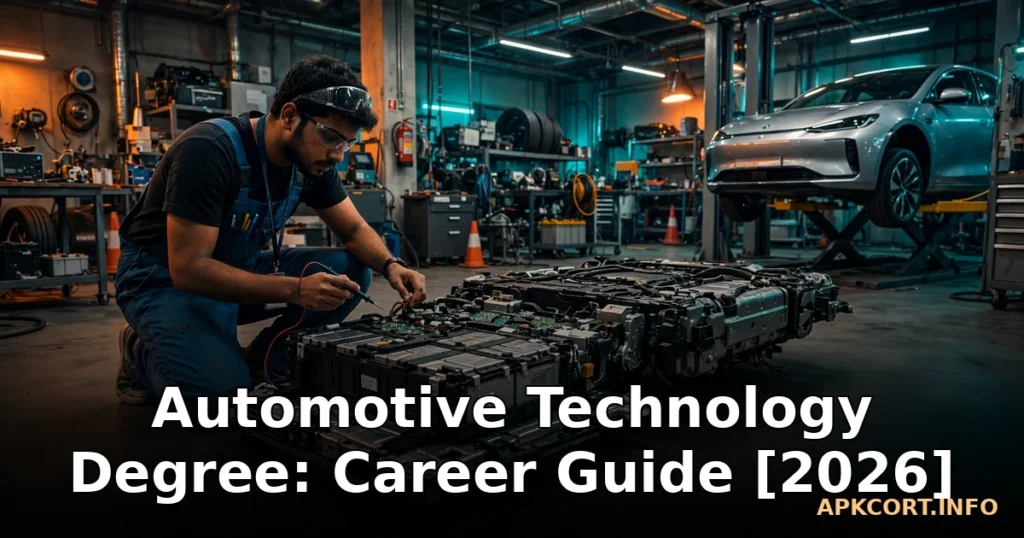
Forget the brochure language. In most Indian colleges this degree is called BTech or BE in Automobile Engineering. It is a four-year engineering program focused on vehicles. You study engines, transmissions, vehicle dynamics, and manufacturing. Since 2026 is the age of electric mobility, you also study battery systems, electric powertrains, and vehicle software, because that is where the new jobs live.
It is not a mechanic's course. You will not spend four years changing oil. You learn the engineering behind why a car handles the way it does, how an EV battery stays cool in Delhi heat, and how factories build thousands of identical vehicles without mistakes.
What You Actually Study
Your subjects look something like this across the four years:
- Vehicle mechanics and engines: how internal combustion engines and electric motors produce power
- Transmission and chassis: gearboxes, suspension, steering, and braking systems
- Electric vehicle systems: battery packs, motor controllers, charging tech, and power electronics
- Manufacturing and quality: how cars get built on assembly lines and how defects are caught
- Vehicle software basics: CAN communication, diagnostics, and the electronics inside modern cars
Who This Degree Suits (Be Honest With Yourself)
This degree suits students who enjoy machines, physics, and figuring out how things work. You do not need to be a topper, but you do need patience with maths. If the thought of an engine diagram excites you, you will enjoy the course.
If you hate physics, skip it. There is no shortcut around thermodynamics and mechanics. Plenty of other tech careers pay well without them.
Automotive Technology Degree: Courses, Fees, and Colleges in India
You do not have to do a four-year BTech to enter this industry. India offers four clear routes, and picking the right one can save you lakhs.
The 4 Routes Into the Industry
- BTech/BE in Automobile Engineering (4 years): the standard route after Class 12 with Physics, Chemistry, and Maths. Opens the most doors.
- Diploma in Automobile Engineering (3 years): after Class 10. Cheaper, more hands-on, and you can join the second year of BTech later through lateral entry.
- MTech in Automotive Engineering (2 years): after BTech, through GATE. Best for research, teaching, and specialist R&D roles.
- Short EV certificates (3 to 12 months): offered by private institutes and platforms. Good for upskilling, not a replacement for a degree.
Top Colleges and What They Actually Charge
Fees swing wildly between government and private colleges.
Government colleges: IIT Delhi, IIT Roorkee, Delhi Technological University, and Madras Institute of Technology. Fees run roughly 50,000 to 1.5 lakh per year. Competition is brutal, but the fees are a fraction of private colleges.
Private colleges: VIT Vellore, SRM Institute, Manipal Institute of Technology, Chandigarh University, and PSG College of Technology. Fees run roughly 1.5 to 3 lakh per year. Across India, total course cost for an automotive technology degree lands between 2 lakh and 11 lakh.
A diploma from a polytechnic costs far less, often around 40,000 per year, with median fresher packages near 2.5 LPA.
Worried about fees? You are not alone. Many students cover part of their costs with part-time work, and this guide on how to earn money online with jobs in India shows realistic options that fit around a college schedule.
Career Options After the Degree
Here is where it gets interesting. The degree opens more doors than most students expect.
EV Jobs: This Is Where the Money Went
Electric vehicles created an entirely new job market in the last five years. Companies are paying a premium for engineers who understand batteries, motors, and power electronics.
- EV software engineer: writes code for motors, infotainment, and diagnostics. Pays roughly 10 to 25 LPA at experienced levels.
- Power electronics engineer: designs inverters and chargers. Pays roughly 8.5 to 19 LPA.
- Battery engineer: works on battery packs and thermal management. Among the hottest roles in 2026.
- EV powertrain engineer: freshers in this niche start at roughly 7 to 13 LPA, well above the average fresher package.
Hiring companies include Tata Motors, Ola Electric, Ather Energy, Bosch India, KPIT, Tata Elxsi, Mahindra, and TVS. Electric mobility is one of the biggest tech shifts of our time, and I covered the wider picture in my article on the role of technology in 2026.
Traditional Auto Roles Still Pay the Bills
Petrol and diesel vehicles are not vanishing tomorrow. Maruti Suzuki, Hyundai, Toyota, Bajaj, and Hero still hire thousands of engineers for design, production, quality control, and service networks. These jobs are stable and everywhere, from Chennai plants to Gurugram offices.
Alternative Paths Nobody Tells You About
Not every automotive graduate works in a factory. Some real options:
- Automotive journalism and YouTube: car reviewers with loyal audiences earn from ads and sponsorships. Short car reviews also do well, and some creators now earn serious money from YouTube Shorts in India.
- EV charging startups: small companies need engineers who can install and maintain chargers.
- Own garage or EV service center: experienced mechanics with engineering knowledge charge premium rates.
- Auto insurance and valuation: companies need technical people who can assess vehicle damage.
Salary Reality: What Freshers Actually Earn
Let us talk numbers, because vague promises help nobody.
The average fresher with an automotive technology degree in India earns between 2.5 and 5 LPA. Diploma holders start near 2.5 LPA. These are real numbers from placement data, not brochure fantasy.
Specialists earn more from day one. EV powertrain and battery roles pay freshers 7 to 13 LPA in good companies. Tata Motors runs an Early Career Program that pays 9.91 LPA to selected engineering graduates while sponsoring their higher studies. At the top end, experienced managers and R&D heads reach 18 to 30 LPA.
One honest warning: your college tier matters. A graduate from IIT Delhi or VIT walks into interviews that a tier-3 college graduate has to fight for. That does not mean a smaller college ruins you. It means you will need internships, projects, and skills to close the gap. Build an EV project in college, learn MATLAB or embedded C, and your resume starts speaking louder than your college name.
How to Get This Degree in India
After Class 12
You need Physics, Chemistry, and Maths in Class 12. Admission happens through entrance exams. JEE Main is the big one for NITs and many private colleges. State exams work too: MHT CET in Maharashtra, KCET in Karnataka, COMEDK UGET, TNEA counselling in Tamil Nadu, and SRMJEEE for SRM. Start preparing in Class 11, not in the last three months.
After Class 10: The Diploma Route
Finish Class 10 and join a three-year polytechnic diploma in automobile engineering. It is hands-on, affordable, and after finishing you can enter the second year of BTech directly through lateral entry. For students who want to start earning sooner or whose families cannot fund a full BTech immediately, this route makes a lot of sense.
Is an Automotive Technology Degree Worth It in 2026?
Here is my honest read.
Do it if you genuinely like vehicles and machines, you are okay with physics and maths, and you are willing to specialize in EVs, batteries, or vehicle software. That combination is employable for the next two decades.
Think twice if you are choosing it only because someone said "EV is the future." The future belongs to skilled engineers, not to degree holders. A mechanical degree with EV skills beats an automotive degree with no projects.
The industry itself is healthy. India is pushing EV adoption hard, charging networks are expanding, and every major manufacturer is hiring. The degree is worth it. Your effort during the degree is what decides the salary.
<h2>Questions People Actually Ask</h2>
Is an automotive technology degree the same as mechanical engineering? Not exactly. Mechanical engineering is broader and covers everything from turbines to robotics. An automotive technology degree focuses only on vehicles: engines, transmissions, vehicle dynamics, and now EV systems. Mechanical graduates can enter the auto industry, but automotive graduates have deeper vehicle-specific knowledge.
### What is the salary of an automotive technology degree fresher in India?
Most freshers earn between 2.5 and 5 LPA. Specialists in EV roles like battery engineering or powertrain design start higher, around 7 to 13 LPA in good companies. Your college, internships, and project work push you toward the higher end.
Can I do an automotive technology degree after Class 10? You cannot join BTech directly after Class 10, but you can join a three-year diploma in automobile engineering. After the diploma, lateral entry lets you join the second year of BTech. Many successful engineers took exactly this path.
### Is automotive engineering good for girls?
Yes. Modern automotive work is about design, software, batteries, and testing, not lifting engines by hand. Women work as design engineers, EV specialists, and quality managers across Tata Motors, Ather, and Bosch India. Your interest matters more than your gender.
Pingback: How to Become an Educational Consultant [2026] - Apk Cort