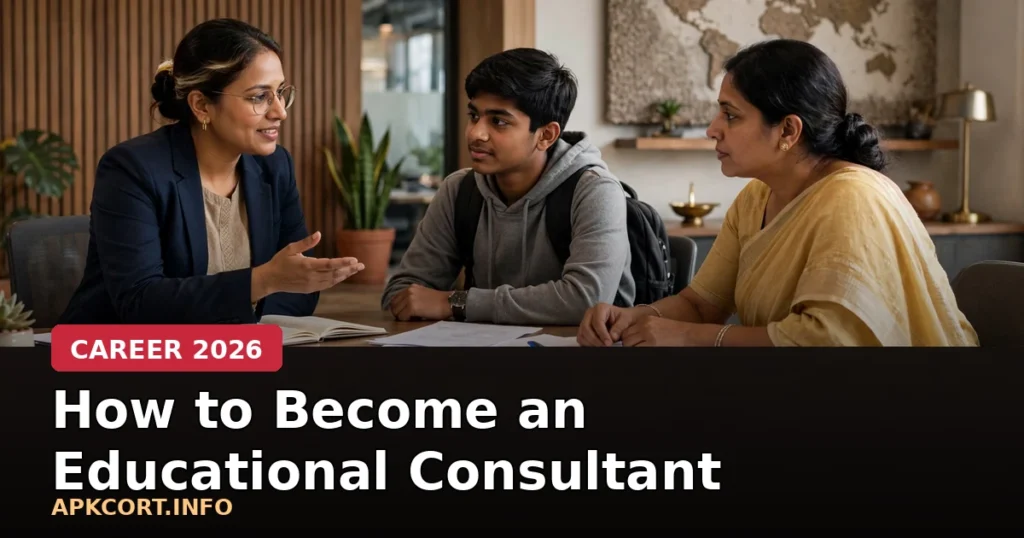
Picture a parent in Mumbai at 11 pm, scrolling through school admission forums, completely overwhelmed. Their daughter scored 91% in Class 10. Science? Commerce? Humanities? Nobody in the family knows enough to decide with confidence. So they do what lakhs of Indian families now do. They book an educational consultant. If you are wondering how to become an educational consultant in India yourself, this guide lays out the complete 2026 roadmap: the skills, the certifications, the pricing in rupees, and how to land your first clients.
Ninety minutes on a video call, a clear action plan, ₹3,000 paid without blinking. That is the business in one scene. And the consultant on the other end of that call? Three years ago she was a schoolteacher in Pune earning ₹38,000 a month. Today she earns more than double that, works from her own home office, and picks her clients. If you know education and you like guiding people, this career deserves a serious look.
What Does an Educational Consultant Actually Do?
An educational consultant is a paid advisor for education decisions. Students, parents, schools, and sometimes companies hire them when the stakes are high and the options are confusing. Think of it as part counsellor, part strategist, part researcher. You do not teach subjects. You help people choose the right subjects, schools, colleges, countries, and careers.
The field splits into clear niches:
- Study-abroad consulting: helping students pick countries, universities, and handle visa applications. The highest-paying niche in India right now.
- School admissions consulting: guiding parents through nursery to Class 11 admissions in cities like Delhi, Mumbai, and Bengaluru, where good schools have waiting lists.
- Career counselling for Classes 9 to 12: stream selection, entrance exam strategy, college shortlisting.
- Special education consulting: advising families of children with learning differences on assessments, school fit, and classroom accommodations.
- Institutional consulting: helping schools improve admissions, plan curriculum, or implement NEP 2020 changes.
Notice something? None of these require you to stand in a classroom. Your product is clarity.
How to Become an Educational Consultant: The Full Roadmap
Here is the honest, step-by-step path. No shortcuts, but also no gatekeeping.
Step 1: Build Real Knowledge Before Anything Else
Clients pay for judgment, and judgment comes from knowledge. Before you take a single rupee, get fluent in the system you will advise on.
For the Indian market, that means: the NEP 2020 structure (the 5+3+3+4 stages replacing 10+2), the real differences between CBSE, ICSE, IB, Cambridge, and state boards, major entrance exams (JEE Main and Advanced, NEET-UG, CUET-UG, CLAT, IPMAT), and realistic admission timelines. If you want the study-abroad niche, add intake cycles (Fall, Spring, Winter), tests like IELTS, TOEFL, GRE, GMAT, and SAT, plus visa basics for the USA, UK, Canada, Australia, and Germany.
You do not need to memorize everything. You need to know where to look and how to verify. A consultant who says "let me check the latest cutoff data and get back to you tomorrow" beats one who bluffs every time.
Step 2: Get a Certification Clients Respect
Strictly speaking, India has no single government license for educational consultants. That is both good news and bad news. Good, because nobody can block your entry. Bad, because anyone can claim the title, so proof of training matters.
Options worth your money in 2026:
- Career counselling certifications from Indian institutes like Univariety, Edumilestones, or iDreamCareer. These typically run 3 to 6 months, cost ₹30,000 to ₹80,000, and teach assessment tools plus real counselling practice.
- Global credentials for the study-abroad niche: ICEF counsellor training or the British Council's education agent training. The British Council course is free online and genuinely respected by UK universities.
- A postgraduate diploma in guidance and counselling (several Indian universities offer one-year programs) if you want academic weight on your profile.
- Short courses on platforms like Coursera in career development or college counselling. Useful as supporting credentials, not as your main one.
Honestly? One solid certification plus visible, current knowledge beats a wall of certificates every time. Clients check your LinkedIn, read your posts, and judge your depth within the first ten minutes of a call.
Step 3: Pick ONE Niche and Own It
Beginners try to serve everyone. Working consultants pick a lane. Your niche decides your marketing, your pricing, and your learning curve.
Ask yourself three questions. Which students do you understand best? Which decisions have you personally navigated? Where is the demand in your city? A former JEE aspirant from Kota understands engineering admissions instinctively. A teacher from a Bengaluru IB school understands international curricula. Play to your lived experience.
The study-abroad lane deserves special attention because it pays the most, and I break it down fully below. But school admissions in metro cities is an underrated goldmine. Parents in South Delhi happily pay ₹50,000 for hand-holding through nursery admissions across ten schools. Competition is lower, trust spreads fast through parent groups, and the work is seasonal, which means predictable busy months.
Step 4: Find Your First 10 Clients
This is where most aspiring consultants stall. The knowledge is ready, the certificate is framed, and then… silence. Clients do not appear on their own. The first ten are the hardest.
What actually works in India:
- Free workshops at local schools. Offer a 45-minute session on stream selection after Class 10. Schools love free value for parents, and you walk out with leads.
- LinkedIn India, used properly. Not motivational quotes. Post breakdowns like "CUET 2026: what changed, and what it means for your child." One useful post a week for three months builds real inbound interest.
- Short video content. Instagram Reels and YouTube Shorts explaining one admission concept per video. Parents share these in WhatsApp groups, which remains India's most powerful distribution channel.
- Parent WhatsApp and Telegram groups. Join as a helper, answer questions generously, and let your expertise do the selling.
- A simple Google Business Profile with your city in the name. Searches like "educational consultant in Pune" convert shockingly well.
Price your first five consultations low, or even free in exchange for detailed testimonials. Social proof is the entire game in the early days.
Step 5: Price Like a Professional, Not an Amateur
Underpricing is the classic beginner mistake. It attracts bargain hunters, exhausts you, and signals low value. Here are realistic 2026 rates for Indian educational consultants:
- Single counselling session (60 to 90 minutes): ₹1,500 to ₹5,000
- Career assessment plus counselling package: ₹8,000 to ₹25,000
- Full school admission guidance (one season): ₹30,000 to ₹75,000
- Study-abroad application package (one country): ₹75,000 to ₹1,50,000
- Monthly retainer for schools: ₹40,000 to ₹1,00,000
Start at the lower end of your niche's range, raise your rates every 10 to 15 clients, and never apologize for charging. You are selling years of accumulated knowledge compressed into decisions that shape a child's future. That is worth real money.
The Skills That Actually Matter More Than Degrees
Nobody hires you for your degree. They hire you for five things.
First, listening. Most consultants talk too much. The best ones ask sharp questions and let the family reveal what they actually fear. Second, current knowledge. Admission rules change every year. CUET patterns shift, visa policies tighten, new courses launch. If your information is from 2022, you are dangerous. Third, communication in the client's language, literally. English plus Hindi or a regional language doubles your market in most Indian cities. Fourth, basic marketing. You can be brilliant and invisible, which pays nothing. Learn to write, post, and follow up. Fifth, ethics. Never push a college or course because it pays you a commission without disclosing it. One exposed conflict of interest ends a consulting career, because word travels fast in parent circles.
For a sense of how detailed, trustworthy career roadmaps are structured, study this automotive technology degree career guide. Notice how specific milestones build confidence step by step. Your counselling should feel exactly that solid to a client sitting across from you.
The Study-Abroad Niche: Where the Serious Money Lives
Let us talk numbers. Over 1.3 million Indian students went abroad for higher education in 2024, according to figures shared by the government in Parliament. The USA, Canada, the UK, and Australia take the bulk, with Germany rising fast because its public universities charge little to no tuition.
Study-abroad consultants earn two ways. Counselling fees from families (₹75,000 to ₹1,50,000 per student for full application support), and commissions from foreign universities, typically 10 to 15 percent of first-year tuition. A single student placed at a UK university charging £20,000 a year can mean ₹2 lakh to ₹2.5 lakh in commission alone. That is why this niche has the highest earning ceiling in the field.
It also has the sharpest ethical edge. Recommending universities based on commission size rather than student fit is mis-selling, and students figure it out eventually. The consultants who last build reputations on honest rejections. "This university is not right for your profile" is a sentence that earns referrals for years.
This niche overlaps heavily with overseas job guidance, since almost every family asks about post-study work options. Keep this guide on jobs in Canada for Indians with visa sponsorship handy for those conversations; clients constantly ask what happens after the degree ends.
Study-abroad consultants also need working knowledge of how education systems around the world compare, because "USA vs Germany vs Australia" is the most common question in every first meeting.
How Much Can You Realistically Earn?
Time for honest numbers, not Instagram fantasy.
Year one, part-time, while you build reputation: ₹20,000 to ₹60,000 a month. Most of your energy goes into free content and low-priced sessions. Year two, full-time with a working referral engine: ₹1 lakh to ₹2.5 lakh a month is realistic for a competent solo consultant in a metro city. Established study-abroad practices with a small team: ₹5 lakh plus in monthly revenue, though staff salaries and office costs take their share.
Your city matters enormously. Delhi, Mumbai, Bengaluru, Hyderabad, and Pune have the density of paying parents. In smaller cities, you will lean on online clients across India, which is completely viable now. Roughly 70 percent of counselling in this field happens over video calls anyway.
The ceiling is high but the floor is real. This is a reputation business. It compounds slowly, then suddenly.
How to Become an Educational Consultant: A Realistic Timeline
From zero to first paying client: three to six months if you market consistently. From first client to full-time income: twelve to twenty-four months. Anyone promising faster is selling you a course, not a career.
That timeline assumes you treat marketing as half the job. The consultants who fail usually fail at visibility, not at knowledge. They know everything and tell nobody.
<h2>Questions People Actually Ask</h2>
Do I need a degree in education to become an educational consultant? No. There is no mandatory degree or government license in India. A teaching or counselling background helps with credibility, but clients buy demonstrated knowledge and results. One respected certification plus proof of current expertise matters more than any single degree.
### How much do educational consultants charge in India?
Single sessions run ₹1,500 to ₹5,000. Packages range from ₹8,000 for career assessment bundles to ₹1,50,000 for full study-abroad application support. School retainers sit between ₹40,000 and ₹1,00,000 a month. Rates vary by city, niche, and reputation.
Is educational consulting a good career option in 2026? Yes, with realistic expectations. Demand is strong: NEP 2020 changes, CUET’s expansion, and record study-abroad numbers keep families confused and willing to pay for clarity. But it is a slow-build reputation business, not quick money. Expect 12 to 24 months before stable full-time income.
### Which consulting niche pays the most?
Study-abroad consulting, by a clear margin, thanks to high package fees plus university commissions. School admissions consulting in metro cities comes second, with lower competition and powerful word-of-mouth dynamics.
Pingback: How to Become a Lawyer in India [2026] - Apk Cort