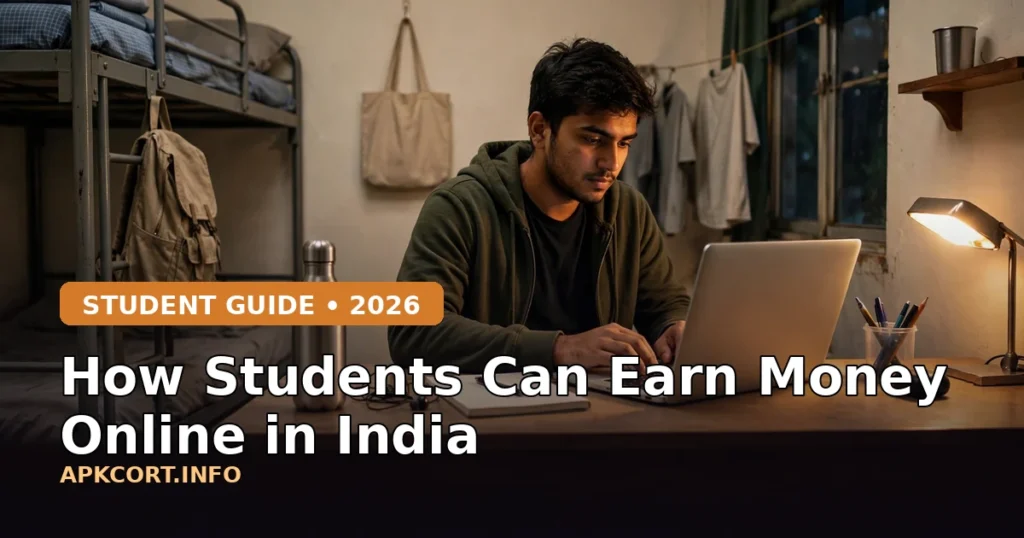
Picture this. It is the 18th of the month. Your pocket money is gone. Canteen coffee is suddenly a luxury. And your phone is full of ads screaming "Earn ₹50,000 per month from your phone, no work needed!"
You have probably wondered whether any of it is real.
Here is my honest answer on how students can earn money online in india. Yes, it is possible. No, it is not fast. And most people selling you shortcuts are making money FROM you, not WITH you.
I have watched students in Delhi, Pune, and Jaipur build side income between classes. Not lakhs. But ₹5,000 to ₹20,000 a month, consistently, alongside a degree. That is real money when you are 20. Let me show you exactly how they do it, what to avoid, and what the pay actually looks like.
First, Let's Kill the Fantasy
Before the methods, we need to agree on three truths. Every legit way of earning online shares these, and every scam violates at least one.
First, nobody pays you for doing nothing. Liking videos, watching ads, forwarding messages to ten friends: if it sounds like free money, you are the product. Second, the first payout always takes time. Your first ₹1,000 might take 30 to 60 days. Reaching ₹10,000 a month usually takes 4 to 6 months of consistent work. Third, real work never asks for a joining fee. The moment someone says "pay ₹499 to unlock the tasks," walk away.
Why am I starting with the boring part? Because students get targeted by scams more than anyone else. You are young, ambitious, and short on cash, which is exactly the combination scammers love. The good news: once your expectations are realistic, the real methods start working.
One more thing. Almost everything below needs zero money to start. Your phone and an internet connection are enough for most of it. If you want a deeper dive into zero-capital approaches, I have a full guide on how to make money online without investment that pairs well with this one.
How Students Can Earn Money Online in India: 8 Legit Ways
1. Freelancing: Sell a Skill You Already Have
This is the fastest realistic route to real money. Businesses need writing, design, video editing, and social media help. Students can learn the basics of any of these in 2 to 4 weeks using free YouTube tutorials.
Where do you find clients? Start with Internshala for Indian internships and freelance gigs. Then try Upwork and Fiverr for international clients who pay in dollars. Even local businesses near your college need Instagram posts and pamphlet designs. A simple WhatsApp message to five local shops can land your first client.
Real numbers: beginner content writers earn ₹0.50 to ₹2 per word, which means ₹500 to ₹2,000 for a 1,000-word article. Basic video editors charge ₹1,500 to ₹5,000 per project. It is not glamorous, but two or three regular clients can comfortably cross ₹15,000 a month.
2. Online Tutoring: Teach What You Just Learned
Here is the beautiful thing about tutoring. You do not need to be a professor. You just need to be one chapter ahead of your student. A second-year engineering student can teach Class 11 physics. A B.Com student can teach accountancy basics.
Platforms like Chegg India pay subject experts per answered question, and active tutors report ₹8,000 to ₹20,000 a month. Vedantu and UrbanPro connect you with students for live online classes at ₹300 to ₹800 per hour. You can also skip platforms entirely and teach school kids in your neighborhood over Google Meet, keeping 100% of the fee.
3. Content Writing and Blogging
Every website, startup, and YouTube channel in India needs words. Product descriptions, blog posts, Instagram captions, video scripts. If you can write clear English (or Hindi, Tamil, Telugu: regional language writers are in SHORT supply), someone will pay you.
Start by writing 3 to 4 sample articles on topics you understand. Post them on LinkedIn or a free WordPress blog as your portfolio. Then apply to content agencies and startups on Internshala and LinkedIn. Many pay weekly or monthly.
Longer term, you can start your own blog. It takes 6 to 12 months to earn from ads and affiliates, so treat it as a slow asset, not quick cash. But a blog earning ₹10,000 a month on autopilot two years from now is worth the patience.
4. Social Media Management for Local Businesses
Walk around any market in India and count the shops with dead Instagram pages. Restaurants, salons, coaching centers, clothing stores: they all know they should post online, and none of them have time.
Offer to handle it. Three posts a week, replying to comments, basic reels. Charge ₹3,000 to ₹8,000 per month per business. Five clients at ₹5,000 each is ₹25,000 a month, and the work takes maybe 10 hours a week once you build a routine.
How do you get clients? Walk in with your phone, show them two sample posts you made for their shop (yes, make them before the meeting), and ask for a one-month trial. Students in tier-2 cities like Indore and Coimbatore are quietly making serious money this way because competition is almost zero.
5. Affiliate Marketing and Referral Programs
You recommend a product. Someone buys through your link. You get a commission. That is the whole model, and it works best for students because you can promote things you genuinely use: the earphones you bought, the app you love, the course that helped you.
Amazon Associates and Flipkart Affiliate are the easiest to join in India. Finance apps like Groww, Zerodha, and CRED pay ₹100 to ₹500 per successful referral. Some students earn more from referral bonuses than from any other method, simply by sharing links in college WhatsApp groups and Telegram channels.
There is actually a whole method built around this idea called link sharing to earn money online, where you earn purely by sharing referral and affiliate links smartly. If the social, no-skill route appeals to you, that guide is worth reading next.
The golden rule: only promote what you would recommend to your best friend. One fake recommendation destroys trust that took months to build.
6. Sell Notes, Templates, and Digital Products
That neat set of semester notes you made? Someone will pay ₹99 for it. Those resume templates you designed in Canva? Sellable. A Notion template for exam planning? Definitely sellable.
Platforms like Gumroad and Instamojo let you sell digital files with zero inventory. You make the product once and sell it a hundred times. A student selling well-organized UPSC or CA notes has reported five-figure monthly income, and the product never runs out of stock.
This method has the best effort-to-income ratio on this list, but it needs one thing upfront: a genuinely useful product. Spend a week making something excellent, not an afternoon making something average.
7. Campus Ambassador Programs and Micro-Internships
Brands desperately want to reach college students, and they will pay students to be their voice on campus. Companies like Swiggy, CRED, Unstop, and various edtech startups run campus ambassador programs that pay ₹2,000 to ₹10,000 per month plus goodies and certificates.
These are easy to get into (just apply), look great on a resume, and teach you marketing skills that feed directly into method 4 above. Check Unstop and Internshala regularly, because new programs open every month.
8. Surveys, User Testing, and Microtasks (The Honest Low End)
Let us be real about this one. Google Opinion Rewards, Toluna, and user-testing sites like UserTesting pay actual money, but the amounts are small. We are talking ₹500 to ₹2,000 a month if you are consistent.
I am including it because it is honest pocket money with zero skill needed, perfect for dead time between lectures. Just never pay to join a survey site, and never believe a site promising ₹50,000 a month for filling forms. That is always a scam.
5 Red Flags: Spotting Scams Before They Spot You
Students get targeted by scams more than anyone. Memorize these five warning signs.
1. Any joining fee or "activation charge." Real employers pay you. They never ask you to pay first. This kills 90% of scams instantly.
2. Telegram groups promising guaranteed returns. "Invest ₹1,000, get ₹5,000 in a week." This is either a Ponzi scheme or a task scam. The RBI and cyber police warn about these constantly.
3. "Typing jobs" and "form filling" with big promises. The classic student trap. They ask for a "security deposit," you pay, and the tasks never arrive.
4. Requests for your OTP, bank login, or Aadhaar details. No legitimate client or platform needs these. Ever. If someone asks, block and report.
5. Pressure to decide NOW. "Only 2 seats left, pay in the next 10 minutes!" Real opportunities do not expire in 10 minutes. Scammers create urgency so you stop thinking.
If you ever doubt an offer, search its name plus the word "scam" or "fraud" on Google and YouTube. Someone has usually already exposed it.
Your First 90 Days: A Simple Plan
Week 1 to 2: Pick ONE method from the list above. Not three. One. Watch free tutorials, make 3 samples of your work, and set up profiles on the relevant platform.
Week 3 to 4: Start applying or reaching out. Aim for 5 outreach messages a day. Expect silence. That is normal. Volume beats perfection.
Month 2: Land your first small client or gig. Do excellent work, even if the pay is low. Ask for a testimonial and a referral. Your second client usually comes from your first.
Month 3: Raise your rates slightly. If freelancing, build a simple portfolio. If tutoring, ask students for reviews. If affiliates, double down on whatever got clicks.
The students who fail are not the ones who pick the wrong method. They are the ones who try all eight for three days each and quit. Depth beats breadth, every time.
<h2>Questions People Actually Ask</h2>
How much can a student realistically earn online per month in India?
With 1 to 2 hours a day, most students reach ₹3,000 to ₹8,000 a month within 3 months. Serious freelancers and tutors working 3 to 4 hours daily cross ₹15,000 to ₹25,000 a month within 6 to 12 months. Claims of ₹1 lakh a month as a beginner are marketing, not reality.
Can I earn money online as a student without any investment?
Yes. Every method on this list except paid ads for your own products needs zero investment. Your phone, free WiFi at college, and free tools like Canva, Google Docs, and CapCut are enough to start. Never pay a “registration fee” to any earning platform.
Will earning online affect my studies?
It can, in both directions. Done badly, it eats study time and your grades slip. Done well, 1 to 2 focused hours a day teaches you time management that actually improves your discipline. The rule: fix your study hours first, then fit earning around them, never the reverse. Exam month? Pause everything. Marks still matter.
Which skills should I learn first to earn online faster?
Writing, basic graphic design on Canva, and video editing on CapCut have the lowest learning curve and fastest client demand. If you are technical, basic web development or Python automation pays more but takes longer to learn. Pick the skill closest to what you already enjoy, because you will need to practice it daily.
Do I need to pay tax on money I earn online as a student?
If your total yearly income stays below the basic tax-free limit, you generally do not owe income tax, but the limit changes with budgets, so check the current figure. UPI and bank transfers leave a trail, so keep simple records of what you earn. When your income grows, talk to a CA or use free tax guides. This is not financial advice, just a nudge to stay clean.
Pingback: How Technology Improves Classroom Teaching [2026] - Apk Cort
Pingback: How Students Can Earn by Freelancing on Fiverr in India [2026] - Apk Cort