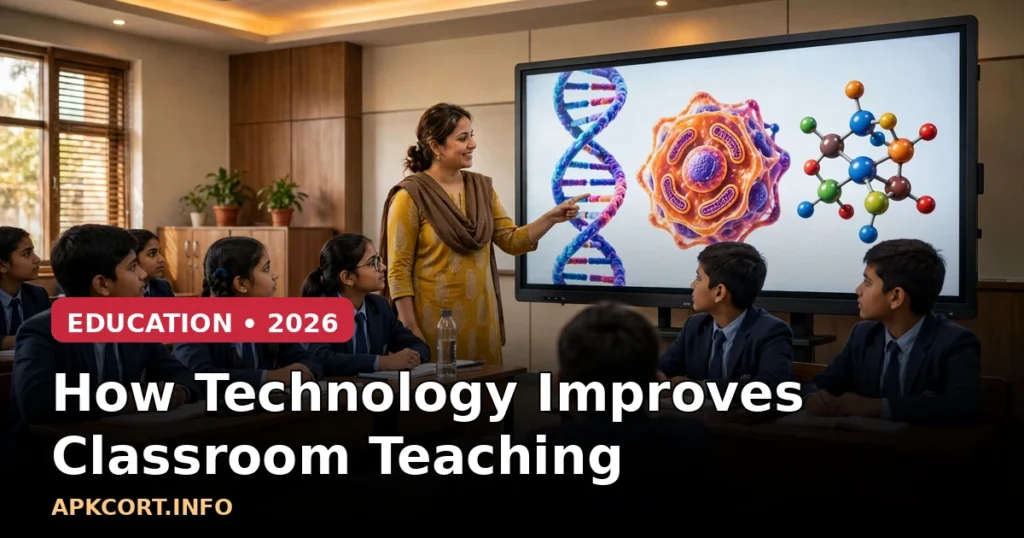
Picture two Class 8 science periods happening on the same morning.
In a Lucknow school, the teacher draws the human heart on the blackboard. Chalk dust, shaky lines, labels squeezed into corners. Half the class copies the diagram into their notebooks without really understanding which chamber does what.
Forty kilometres away, another teacher projects the same heart onto a screen. It beats. Blood flows through each chamber in colour. A student asks about the valves before the teacher even reaches that slide. Everyone leans forward.
Same chapter. Same 45 minutes. Completely different energy.
That is what technology in classroom teaching actually does. It doesn't replace the teacher. It hands her a louder voice and a bigger canvas. And in 2026, this is no longer a metro-city luxury. With close to 15 lakh schools and over 26 crore students (UDISE+ data), India is pushing digital tools into small-town and village classrooms too. Some of it works beautifully. Some of it is pure show. This guide separates the two, with real tools, real costs, and honest advice.
First, What Classroom Technology Is NOT
Before the good stuff, let's kill the myths. Technology in classroom teaching is not:
- A teacher replacement. No app notices the quiet kid in the third row who stopped eating lunch. Teachers read rooms. Screens don't.
- Just a projector. Showing the same boring lecture on a bigger screen changes nothing. The method has to change, not just the medium.
- Automatically better. A badly planned digital lesson confuses students faster than a good chalk-and-talk lesson ever could.
- Only for rich schools. Some of the best classroom tech in India right now is free: DIKSHA, SWAYAM, YouTube. Money helps, but intent matters more.
Keep these in mind. They'll save you from every sales pitch a smart-board company throws at you.
6 Ways Tech Genuinely Makes Teaching Better
1. Abstract ideas become visible. Try explaining the solar system, a chemical reaction, or how the heart pumps using only words. Now show it in 3D animation. Concepts that took three periods to explain land in one. This is the single biggest win, especially in science and maths.
2. Every student gets a rewind button. Record the lesson, upload it, done. The kid who was absent with fever watches it at home. The slow learner replays the tricky part five times without embarrassment. Nobody had this option in the chalk era.
3. Practice adjusts to each student. Adaptive apps change question difficulty based on answers. A Class 6 student in Indore struggling with fractions gets simpler problems first, then climbs up. The quick learner next to her jumps straight to the hard set. One classroom, thirty different speeds, and it actually works.
4. Checking work takes minutes, not weekends. Google Forms and similar tools auto-grade MCQs and short answers. A teacher handling 120 students across four sections can save four to five hours every single week. That time goes back into actual teaching. Or sleep. Both are badly needed.
5. Shy students finally participate. Live polls, quiz apps, chat answers. The back-bencher who would never raise his hand will happily tap an answer on a shared tablet. Participation stops being a personality contest.
6. Students build real digital skills as a side effect. This one compounds over years. Kids who grow up comfortable with technology, searching well, judging online information, making presentations, carry that confidence into college and jobs. Some start earning even before they graduate. If you're a student reading this, here's how students can earn money online in India with realistic, no-investment options.
The Tools Indian Teachers Actually Use
Forget the glossy brochures. Here's what's really inside classrooms right now.
Free Government Platforms (Start Here)
DIKSHA is the government's digital backbone for school education, with courses and videos in 30+ Indian languages, aligned to NCERT and state boards. Free. Runs on cheap phones. Content can be downloaded for offline use, which matters where the network drops every evening.
SWAYAM offers full courses from Class 9 up to postgraduate level, also free, with an optional certificate exam for a small fee. Teachers use it for their own upskilling as much as for students.
PM eVidya runs 200 DTH TV channels, roughly one per class and subject, so even a home with no internet but a dish connection gets lessons. In villages with patchy 4G, this quietly does more than any app.
e-PG Pathshala covers postgraduate e-content. Useful for college lecturers who want ready-made material.
What Schools Buy
Interactive flat panels (the modern smart board) cost roughly ₹80,000 to ₹2,00,000 for a 65 to 86-inch screen. Add a content subscription from providers like Tata ClassEdge or Extramarks, and a single smart classroom typically costs ₹1.5 to ₹4 lakh in the first year, then an annual renewal after that.
Worth it? Only if teachers are trained to use them. An expensive panel used as a plain projector is the most common waste of money in Indian school tech. Ask any honest principal.
What Individual Teachers Use on Their Own
Google Classroom for assignments and announcements. Free, runs on any phone. WhatsApp groups for homework reminders and doubt-clearing, because that's where parents actually are. YouTube, where channels like PhysicsWallah and Khan Academy Hindi explain concepts better than many textbooks. Many teachers now record their own short explainer videos and share them directly with students.
One honest side note here. Teachers who learn video editing, slide design, and AI tools often start earning outside school too: tuition channels, their own blogs, freelance content work. If that idea appeals to you, read how to start online earning from blogging with ChatGPT for a practical starting point.
And here's the part schools skip: none of these tools help if the teacher is nervous about switching on a projector. If basic digital skills still feel shaky, this guide to basic computer skills every student should learn is an equally good starting point for teachers.
What Does All This Actually Cost?
Real numbers, because vague advice helps nobody:
- Zero-budget classroom: DIKSHA + YouTube + Google Classroom + one teacher's phone mirrored to any old TV. Cost: practically ₹0 beyond devices you already own.
- One smart classroom: ₹1.5 to ₹4 lakh in year one (panel + content subscription + installation).
- School-wide rollout (20 classrooms): ₹30 to ₹80 lakh, which is why most schools phase it over years or pick 5 to 10 priority rooms first.
- Recurring costs people forget: annual content renewals, panel repairs, internet bills. Budget 15 to 20 percent of the setup cost every year.
- Teacher training: often quoted free by vendors, but real training costs time and sometimes a trainer's fee. Don't skip it to save money.
My take: if your school can't afford panels yet, don't wait. A ₹15,000 projector plus free DIKSHA content beats a dusty ₹2 lakh panel nobody knows how to use.
The Problems Nobody Warns You About
Honest section. Tech in classrooms has real failure modes, and you should know them before spending a rupee.
Power cuts and patchy internet. Plenty of rural schools still deal with daily outages. A lesson plan that dies when the WiFi dies is a bad lesson plan. Always keep an offline backup: downloaded videos, a printed worksheet, chalk as plan B.
Two-day training, then abandonment. Schools buy panels, train teachers for a weekend, and declare victory. Real comfort takes months. The schools that succeed assign one tech-savvy teacher as the go-to helper for everyone else.
Expensive screens, same old lecture. If the teacher just reads slides aloud, students learn less than they would from an energetic blackboard session. The screen didn't fail. The teaching method did.
The homework gap. Classroom tech means nothing if half the class has no device or data at home. Assignments that assume every child has a smartphone quietly punish poor students. Keep core homework doable offline.
Distraction is real. Give thirty teenagers tablets and some will find games within minutes. Classroom management software and clear rules help, but there's no technical fix for this one. It's a teaching challenge, not a tech problem.
How to Start Small: A 5-Step Plan
Don't digitize your whole syllabus in a week. Do this instead:
- Pick one chapter, not one subject. Choose the topic students always find hardest. Teach it with one video and one quiz. See what happens.
- Use free content first. DIKSHA and YouTube already have quality material for almost every NCERT chapter. Don't pay for content until the free options genuinely fall short.
- Find one buddy teacher. Everything is easier in pairs. Share what worked, steal what worked for them.
- Give it one hour a week of your own learning time. One new tool per month is plenty. Speed kills motivation here.
- Measure one thing. Pick a single metric: quiz scores on that chapter, or how many students submitted homework. If it improves, expand. If not, change the approach, not the tool.
<h2>Questions People Actually Ask</h2>
Does technology replace teachers in the classroom?
No, and it won’t in 2026 either. Technology handles repetition, visualization, and grading. Teachers handle motivation, discipline, curiosity, and the human judgment of noticing when a student is struggling silently. The best results come from teachers plus tech, never tech alone.
How much does a smart classroom cost in India?
A single smart classroom typically costs ₹1.5 to ₹4 lakh in the first year, covering an interactive panel, content subscription, and installation. Budget another 15 to 20 percent yearly for renewals and repairs. A zero-budget version using DIKSHA, YouTube, and a basic projector costs almost nothing.
Can classroom technology work in villages with poor internet?
Yes, with the right choices. DIKSHA content can be downloaded for offline use, PM eVidya’s 200 DTH channels need only a dish connection, and preloaded tablets work without any network at all. The mistake is planning lessons that assume constant high-speed internet.
Which is the best teaching app for Indian teachers?
There is no single best app. Use Google Classroom for managing assignments, DIKSHA for curriculum-aligned free content, and YouTube channels like PhysicsWallah or Khan Academy Hindi for concept explanations. Pick tools that solve your specific problem instead of chasing one perfect app.
Do students actually learn more with smart classes?
Honestly, it depends on the teacher more than the technology. Classrooms where teachers are trained and engaged show better attention and recall. Classrooms where an expensive panel just displays slides show little difference. Technology multiplies teaching quality in both directions.
Pingback: Basic Computer Skills Every Student Must Learn [2026] - Apk Cort
Pingback: What Is the Real Goal of Education? - Apk Cort
Pingback: Why Education Is Important in 2026 - Apk Cort
Pingback: Education Systems Around the World Compared - Apk Cort