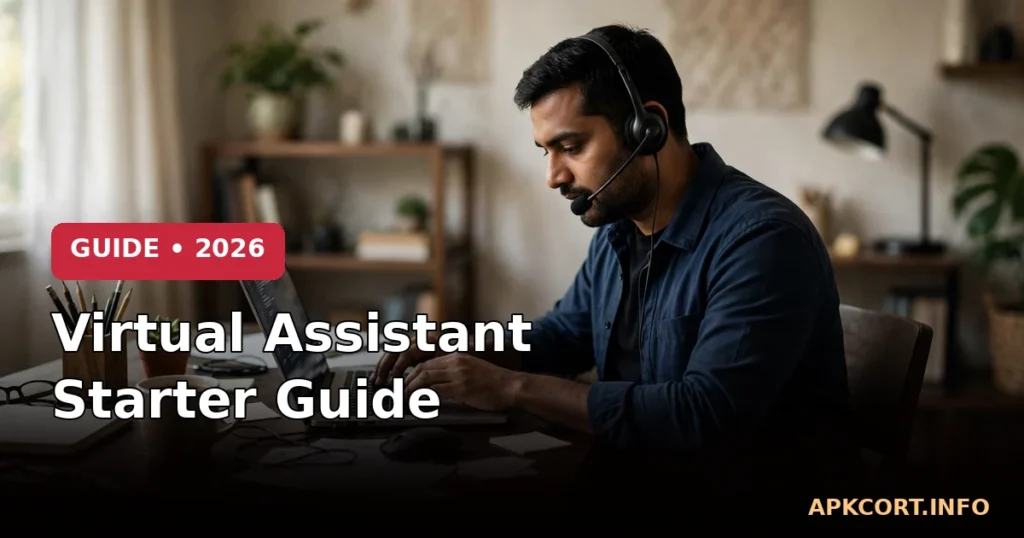
What if your job was answering emails, managing calendars, and booking train tickets for a startup founder in Mumbai, all from your bedroom in Indore? That is the daily life of a virtual assistant India clients hire every single day: a remote helper who handles the operational work busy people do not have time for.
No office. No commute. No boss standing behind your chair. Just your laptop, your skills, and clients who pay you every month. This guide lays out exactly which skills to learn, where to learn them for free, what to charge in rupees, and where your first clients are hiding.
What Indian Virtual Assistants Actually Get Paid To Do
Forget the vague definition. Here is the real task list clients hand to VAs, based on actual job posts on Indian freelancing platforms:
Inbox and calendar management. Sorting emails, flagging the urgent ones, scheduling meetings across time zones, sending polite follow-ups. This single service is the bread and butter for at least half of all VA work.
Data entry and spreadsheets. Cleaning up messy Excel sheets, maintaining lead lists, updating CRMs, preparing weekly reports. Boring? A little. Steady paying? Very.
Travel and appointment booking. Flights, hotels, doctor appointments, restaurant reservations. Founders outsource this first because it eats their evenings.
Social media assistance. Scheduling posts, replying to basic DMs, pulling simple performance numbers at month end. Not full content creation; that is a separate, higher-paid skill.
Customer support chat and email. Answering routine queries for small e-commerce stores and coaching businesses. Many Shopify sellers in India hire VAs just for this.
Basic bookkeeping support. Raising invoices, tracking payments, nudging clients who pay late. You are not the accountant; you are the organized person who keeps the accountant's life easy.
Research tasks. "Find me 50 wedding planners in Jaipur with Instagram handles." "Compare three email tools for a 10-person team." Clients pay surprisingly well for clean, well-organized research.
Notice something? None of these require a degree in anything. They require reliability, decent English, and comfort with everyday online tools. If you are already the organized friend in your group, you are halfway there.
This is also one of the most realistic answers to getting a remote job in India without experience, because VA clients care far more about what you can do this week than what your resume looked like last year.
The Skill Roadmap: Learn in This Order
Do not try to learn everything at once. Beginners drown in tutorials. Learn in this sequence, and each layer makes you charge more:
Layer 1: Communication basics (week 1-2). Write clear professional emails. Learn the difference between a vague message ("done") and a useful one ("Done. The sheet is updated through row 240, and I flagged 3 duplicate entries in yellow."). Practice summarizing long threads into short updates. Clients pay for clarity.
Layer 2: Google Workspace and MS Office (week 2-4). Gmail filters and labels, Google Calendar sharing, Sheets formulas (VLOOKUP/XLOOKUP, pivot tables, conditional formatting), Docs formatting, Slides basics. These sound basic until you watch a client pay ₹500 an hour to someone who does them fast.
Layer 3: One scheduling and one project tool (week 4-5). Pick Calendly for scheduling and either Trello or Asana for task boards. Most small businesses run on exactly these. Being the person who already knows them is an instant hiring advantage.
Layer 4: A specialization (month 2-3). This is where rates jump. Options that Indian clients actually hire for:
- Canva design for social posts and presentations
- Email marketing tools like Mailchimp or Brevo
- Shopify/WooCommerce store assistance
- Basic video editing with CapCut
- Lead generation and LinkedIn outreach
Layer 5: Client management skills (ongoing). Weekly update emails, time tracking with tools like Toggl, invoicing, setting boundaries politely. The VAs who keep clients for years are not the most skilled; they are the most dependable.
Free Learning Paths That Actually Work
You do not need a ₹30,000 course. Here is a learning stack that costs nothing:
YouTube. Search for "virtual assistant training" and "Google Sheets full tutorial." Channels that teach VA skills step by step are everywhere. The trick is picking one playlist and finishing it instead of sampling twenty videos.
Internshala Trainings. Internshala runs affordable and sometimes free introductory trainings, and its job board lists genuine VA and remote internships for Indian students. It is one of the few platforms built specifically for the Indian market.
Google's free certificates. The Google Digital Garage and Grow with Google programs offer free courses in digital skills and project management basics. A certificate with Google's name on it carries real weight with Indian clients.
HubSpot Academy. Free, well-structured courses in email marketing, content marketing, and CRM basics. Finish two or three and you can honestly list email marketing as a service.
Practice clients. Your fastest teacher is real work. Offer two weeks of free VA help to a local business, a relative's shop, or a college society. You get testimonials and real examples for your portfolio; they get free help. Everybody wins.
One rule: cap learning at 30 days before you start applying. The beginners who earn fastest are not the most trained; they are the ones who started pitching while still learning.
Building Service Packages With Real Rate Cards in Rupees
Hourly billing confuses Indian clients and punishes you for getting faster. Packages are cleaner. Here are starter packages that real Indian VAs use, with honest numbers:
Starter package: ₹8,000/month
- 20 hours per month of general VA support
- Email sorting, calendar management, data entry
- Best for: solo founders and small shop owners
Growth package: ₹18,000/month
- 40 hours per month
- Everything in Starter, plus social media scheduling and basic Canva designs
- Weekly update report included
- Best for: coaches, consultants, small agencies
Specialist package: ₹30,000 to ₹45,000/month
- 60 to 80 hours per month
- Everything in Growth, plus one specialization (email marketing, Shopify support, or lead generation)
- Best for: startups and e-commerce sellers who need a real right hand
Per-project pricing for beginners:
- Inbox cleanup and organization: ₹1,500 to ₹3,000 one-time
- Research list (100 verified leads): ₹2,000 to ₹4,000
- Presentation design (10 slides): ₹1,500 to ₹2,500
Start at the lower end of these ranges for your first two clients, then raise prices with every new testimonial. A VA with six months of proof routinely charges double what a beginner does for the same hours.
When you start pitching, a clean one-page profile matters more than a long resume. If you only have a phone, here is how to create a professional resume on your phone in under an hour.
Where to Find Your First Clients
Clients do not fall from the sky. They come from five places, ranked by how fast beginners actually land work:
1. Upwork and Indian freelancing platforms. Create a profile that names your services specifically ("I manage inboxes and calendars for busy founders") instead of generically ("hardworking VA"). Send 5 tailored proposals a day. Most beginners land their first client within 30 to 50 proposals.
2. Internshala. Its remote internship and fresher job listings regularly include virtual assistant roles from Indian startups. Lower pay than direct clients, but real experience and a company name for your profile.
3. LinkedIn. Post twice a week about what you are learning and the problems you solve. Comment helpfully on founders' posts. Two of my known VA friends got their steadiest clients from LinkedIn DMs, not job boards.
4. Fiverr. Package one clear service as a gig, like "I will organize your Gmail inbox in 48 hours." Beginners doing freelancing on Fiverr in India often find that one sharp gig outperforms ten vague ones.
5. Your own network. Tell everyone what you do now. That uncle with a textile shop? He needs invoice follow-ups. Your college senior's startup? They need research help. Warm introductions close ten times faster than cold proposals.
A word on pricing conversations: quote your package price confidently and stop talking. Beginners lose deals by immediately discounting themselves before the client even reacts. State the price, explain what is included, and let them decide.
Your First 30 Days: A Simple Game Plan
Enough theory. Here is your month, week by week:
Days 1 to 7: Build the foundation. Finish one Google Sheets tutorial and one email-writing guide. Set up a professional Gmail address (firstname.lastname@gmail.com, not cooldude1999). Create your Upwork and LinkedIn profiles.
Days 8 to 14: Create proof. Do a free two-week trial project for one local business or a friend's venture. Document everything with screenshots. Ask for a written testimonial at the end.
Days 15 to 21: Start pitching. Send 5 proposals a day on Upwork. Post your availability on LinkedIn. Message ten people in your network. Track every application in a sheet so you can follow up.
Days 22 to 30: Follow up and deliver. Most beginners never follow up, which is exactly why you should. A polite "just checking in" message after five days revives dead conversations. If you landed a trial client, over-deliver this week; that testimonial becomes your next pitch's strongest line.
Thirty days of this routine beats six months of "getting ready." The market rewards motion, not perfection.
<h2>Questions People Actually Ask</h2>