Picture this. It is 6:40 in the evening, monsoon rain is hammering down in Pune, and you are sitting in an auto that has not moved for twenty minutes. The signal ahead is red, even though there is no traffic coming from the other side. Your phone buzzes. Your friend, who left ten minutes after you, is already home. She took a different road, the one the traffic app told her about.
That small moment is the whole idea behind smart cities. Not robots doing everything. Not some science fiction movie. Just technology quietly fixing the thousand tiny frustrations of city life: the dead signal, the water tanker that never arrives, the streetlight that stays off for a month.
Honestly, most of us hear "smart city" and imagine something far away and foreign. But in 2026, it is happening in Indian cities too. Bengaluru, Pune, Surat, Indore and dozens of others are running projects under the Smart Cities Mission that change how people actually live day to day. Let me walk you through what that really looks like, what works, what is still messy, and why you should care even if you never read a government press release in your life.
What a "smart city" actually means (it is simpler than you think)
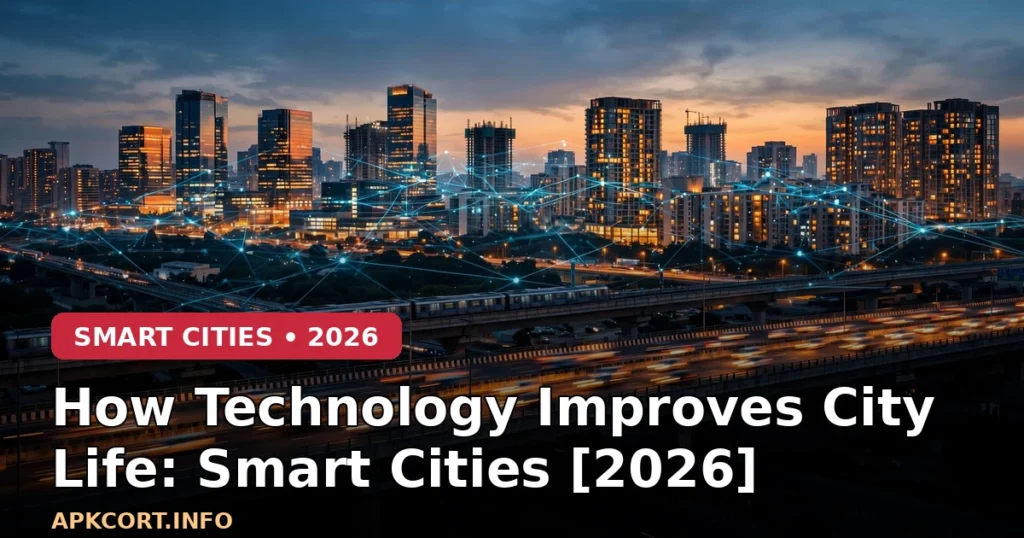
Forget the buzzword. A smart city is just a city that uses data and connected devices to run its basic services better. Sensors count cars at a junction. Cameras watch for garbage pile-ups. A phone app tells you exactly when your bus will arrive. A control room sees it all on one big screen and sends help where it is needed.
India's Smart Cities Mission started back in 2015, and by 2026 over 100 cities have active projects running. The Indian government has put roughly ₹1.6 lakh crore of planned investment behind the mission. Some of it is very visible, like smart roads with cycle tracks in Coimbatore. Some of it is invisible, like underground sensor networks in Surat. Both matter.
Traffic is the first thing smart cities fix, and you feel it immediately
Ask anyone in Bengaluru what ruins their day, and the answer is traffic. The average Bengalurean loses over 130 hours a year to congestion, according to traffic data trackers like TomTom. That is more than five full days sitting in a vehicle going nowhere.
Smart cities attack this with adaptive signals. A normal traffic signal runs on a fixed timer: 60 seconds green, 30 seconds red, whether cars are there or not. A smart signal watches the road with cameras and changes its own timing. Fewer cars waiting? The light flips faster. Empty road on one side? It skips that phase entirely.
Pune's command center manages hundreds of such signals. Surat runs a similar system. The results are not magic, nobody will tell you traffic has vanished, but junction by junction, travel times drop by 10 to 20 percent. That is real time back in your day.
Then there is public transport. Delhi Metro's app, Mumbai's Chalo app, and similar systems in other cities now show live bus locations. You stop guessing and stop standing at a bus stop for forty minutes. Real talk: this one feature pulls more people onto buses, which means fewer cars and less traffic for everyone.
Water, power and garbage: the boring stuff that matters most
Nobody posts Instagram reels about a water pipeline. But for lakhs of families, this is where smart cities change life the most.
Indian cities lose a shocking amount of treated water to leaks, sometimes 30 to 40 percent of the supply just disappears underground. Smart cities fight back with pressure sensors and flow meters along the pipeline network. When pressure drops in one zone, the system flags a probable leak, and a repair team goes straight to the spot instead of digging up half a road to find it. In cities like Nagpur and Udaipur, this kind of monitoring has helped utilities spot losses they never knew existed.
Power gets smarter too. Smart meters, which discoms are rolling out in crores across India, show you exactly how much electricity you used yesterday, this morning, this hour. No more surprise ₹4,000 bills. You see the number climb when the AC runs all night, and you adjust. Cities also use smart streetlights that dim when nobody is around and brighten when someone walks past. Rajkot and Gwalior have installed tens of thousands of LED smart lights. Each one saves power and, this matters, each one can report when it fails. So a dead streetlight gets fixed in days, not months.
Garbage sounds unglamorous until your lane smells for a week. Smart bins with fill-level sensors tell the collection truck which bins are actually full, so routes get planned properly. Indore, which has been India's cleanest city for years running, combines GPS-tracked garbage trucks with citizen reporting apps. You can literally watch whether your area's truck did its round.
Safer streets, faster emergency response
CCTV networks get a lot of debate, and the privacy questions are fair. But here is the practical side: integrated command centers in cities like Ahmedabad and Lucknow pull camera feeds, emergency call data and traffic info onto one screen. When there is an accident, the control room spots it fast, dispatches an ambulance, and turns nearby signals green to clear the route.
Response times matter. In a cardiac emergency or a major accident, ten minutes can decide everything. Smart city emergency systems in several Indian cities have cut average response times to under 15 minutes in core zones. That is not a statistic to you. That is your father getting an ambulance before it is too late.
Women's safety apps and panic buttons at smart bus stops are part of the same package. They are not perfect, no honest person would claim the problem is solved, but a lit, camera-monitored bus stop with a working panic button is a real improvement over a dark corner.
Clean air and green spaces get measured now
Here is something interesting. You cannot fix what you do not measure. Smart cities have installed air quality monitors across neighbourhoods, and the data is public. Open the Sameer app by the Central Pollution Control Board, or check aqicn.org, and you can see your area's AQI right now.
Why does that change anything? Because when residents of a locality in Delhi can see their AQI hit 400 on Diwali night, they complain with numbers, not vibes. Municipal bodies feel pressure backed by data. Cities have started linking this data to action: sprinkling water on dusty roads when PM10 spikes, restricting construction on bad-air days, rerouting traffic away from schools during peak pollution hours.
The money side: jobs, startups and cheaper living
All of this hardware and software needs people to build and run it. The smart city projects have created work for engineers, data analysts, field technicians and app developers across India. Startups building traffic cameras, water sensors and civic apps have found their first big customers in municipal corporations.
Digital payment of property tax, water bills and fines through city apps also kills a classic Indian headache: the trip to the government office. Pay online in two minutes instead of losing half a day. If you have ever stood in a queue at a municipal office in July, you know exactly what that convenience is worth.
What smart cities still get wrong (the honest part)
I would not be doing my job if I only listed the wins. Plenty is broken or overhyped.
First, the digital divide. A fancy city app helps you only if you have a smartphone and data. Lakhs of daily-wage workers, elderly residents and slum dwellers get left out of systems designed for the app-using middle class. A smart city that ignores them is not smart, it is just expensive.
Second, maintenance. Sensors break. Cameras go offline. Apps stop getting updated after the launch event photos are taken. I have seen smart bus stops in Indian cities where the display screen died within a year and nobody fixed it. Technology without maintenance budgets is decoration.
Third, data privacy. All those cameras and sensors collect information about where you go and when. India now has the DPDP Act for data protection, which is good, but citizens rarely know what data their city collects or how long it is kept. Ask questions. It is your data.
Fourth, the basics still lag in many places. A city can have a gleaming command center and still have open drains in the next lane. Technology cannot replace drains, footpaths and honest governance. It can only multiply what is already there.
How you can actually use smart city services today
This is the part most articles skip. Enough theory. Here is what you can do this week:
Download your city's app. Most smart cities have one: Pune's PMC app, Surat's citizen app, Indore's municipal app. You can pay bills, report potholes, track garbage trucks and file complaints with photo proof. Complaints filed through the app get a tracking number, which is much harder for officials to ignore than a phone call.
Check AQI before planning outdoor activity. If you have kids or elderly parents, the Sameer app or a quick Google search for your area's AQI takes ten seconds and tells you whether that morning jog is a good idea.
Use live transit tracking. If your city has it, stop guessing bus timings. The Chalo app covers Mumbai and several other cities. Delhi Metro's app shows train timings and gate info. A small habit change, big daily relief.
Report, don't just rant. See a broken streetlight? A garbage pile? Report it in the app instead of only complaining in your housing society WhatsApp group. Reported complaints create data, and data is what makes the whole smart city machine work.
Under the hood, all of this runs on connectivity. Sensors, cameras, apps and control rooms constantly talk to each other over mobile and wireless networks, and if you are curious how that invisible layer works, this explainer on how wireless technology connects everyday devices is worth a read. Zooming out further, smart cities are one chapter of a bigger story about how technology is changing everyday life in 2026.
<h2>Questions People Actually Ask</h2>
Pingback: Best Web Hosting for Pakistani Websites [2026] - Apk Cort