At a wedding in Patna last year, a Class 12 student told me he wanted to "become a radiology doctor." Then, in the same breath, he said he didn't want to study for ten years.
I asked him what exactly he wanted to do. He shrugged. "The X-ray thing. The machine thing. You know."
He didn't know. And honestly, most people don't. The person who operates the MRI machine and the doctor who reads your scan are two completely different professionals, with different courses, different salaries, and different daily lives. Mixing them up is the most common career confusion in medical admissions after "MBBS vs BAMS."
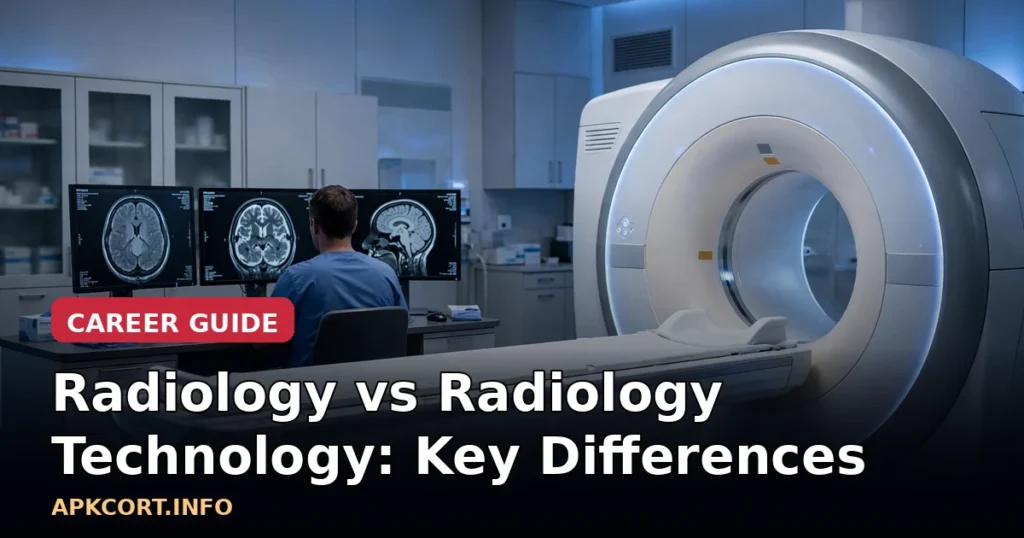
So let's settle radiology vs radiology technology once and for all. Short version first: a radiologist is a doctor who interprets medical images and writes the diagnosis. A radiology technologist is the trained professional who operates the imaging machines and captures those images. One reads the scan. The other takes it. Now the full picture.
The One-Paragraph Difference
Radiology is a medical speciality. The radiologist completes MBBS, then spends three more years on an MD in Radiology, learning to study X-rays, CT scans, MRIs, and ultrasounds and spot what's wrong. When your doctor says "the radiologist's report shows a fracture," that's this person.
Radiology technology is an applied health science. The technologist does a B.Sc. or diploma in medical imaging technology, learning to operate the machines, position patients correctly, set the right radiation dose, and produce clear images. When you lie inside the MRI machine and hear the loud thumping, the technologist is the one running the show from the control room.
Think of it like this: the technologist takes the photograph, the radiologist reads what it means. Both are essential. Neither can do the other's job.
What Each One Actually Does, Hour by Hour
A Radiologist's Day
Most radiologists spend their day in dim reporting rooms, studying scan after scan on high-resolution monitors. A single radiologist in a busy hospital might read 50 to 100 X-rays plus a dozen CT or MRI scans in one day. They write detailed reports, discuss tricky cases with surgeons and physicians, and perform image-guided procedures like biopsies in interventional radiology.
The pressure is real. A missed tumour on a scan can change someone's life, and the legal responsibility sits with the radiologist. Night and emergency duties exist too: when a road accident victim needs an urgent CT at 2 AM, the radiologist reads it. The upside: minimal running around wards, fairly structured hours in many setups, and teleradiology now lets some radiologists report scans from home for hospitals in other cities.
A Radiology Technologist's Day
Technologists are on their feet and with patients all day. They schedule scans, screen patients for metal implants before MRIs, calm nervous children and elderly patients, position bodies precisely (a tilted X-ray can hide a fracture), set exposure parameters, and check image quality on the console. Between patients, they maintain equipment and follow strict radiation safety protocols.
It's physical, people-facing work with shift duties, including nights and weekends in hospitals. The emotional side is underrated: you'll handle trauma cases, scared kids, and seriously ill patients. If you like machines and people in equal measure, it fits well. If you hate shift work, think twice before signing up.
Follow One Patient Through the System
Mrs. Sharma, 58, from Jaipur, has knee pain. Her orthopaedic doctor orders an MRI.
The technologist calls her in, asks about implants and pacemakers, helps her onto the table, positions the knee inside a coil, and runs the 25-minute scan from the control room, talking to her through a speaker the whole time. The images flow into the hospital's PACS, its digital image storage system.
The radiologist opens those images, studies the cartilage and ligaments slice by slice, and writes a report: meniscus tear, grade 2. That report goes back to the orthopaedic doctor, who plans the treatment.
Two professionals. One scan. Zero overlap in their actual tasks.
One more thing about the technologist's side: modern imaging runs entirely on computers. PACS archives, DICOM viewers, hospital information systems. You'll live inside this software every day, so comfort with computers isn't optional. If yours is shaky, work through these basic computer skills for students before you join. Your first month on the job will thank you.
Courses, Years, and Fees in India
This is where the two paths split hard.
Becoming a Radiologist: The Long Road
- Class 12 with Physics, Chemistry, Biology. Score well.
- NEET-UG, competing with 23+ lakh students for roughly 1.1 lakh MBBS seats.
- MBBS: 5.5 years including internship. Fees range from under ₹10,000 total at AIIMS and government colleges to ₹50 lakh–₹1 crore at private colleges.
- NEET-PG, then MD in Radiology: 3 more years. Radiology consistently ranks among the most competitive MD branches, needing a top rank to get in.
Total: about 9 to 10 years after Class 12. Total cost: anywhere from nearly free to over a crore, depending on your colleges.
Becoming a Radiology Technologist: The Shorter Road
- Class 12 with PCB (some colleges accept PCM too).
- B.Sc. in Medical Imaging Technology / Radiology Technology: 3 to 4 years. Or a diploma: 2 years.
- No NEET required at most colleges. Admissions are usually merit-based or through state paramedical entrance tests.
Total: 2 to 4 years after Class 12. Fees are typically ₹1 to ₹4 lakh for the full course at most private colleges, less at government ones.
Read that twice. One path takes a decade and possibly a crore. The other takes three years and a few lakhs. That gap explains almost everything about the salary difference below.
Salary: The Honest Numbers for 2026
- Radiologist (fresher MD): ₹1.2 to ₹2.5 lakh per month in private hospitals, which is ₹15 to ₹30 lakh a year. Government posts start around ₹1 to ₹1.4 lakh monthly.
- Radiologist (experienced, 8–10 years): ₹3 to ₹5 lakh per month in metros, more with teleradiology side work or a partnership in a diagnostic centre.
- Radiology technologist (fresher): ₹20,000 to ₹35,000 per month, roughly ₹2.5 to ₹4 lakh a year.
- Technologist (experienced/senior): ₹45,000 to ₹80,000 per month. Chief technologists in large hospitals touch ₹1 lakh.
Yes, radiologists earn roughly 3 to 5 times more. They also spent six extra years studying and, in many cases, lakhs more in fees. Whether that trade is worth it depends on your appetite for long study, your NEET reality, and your family's finances. There is no universally right answer here.
Work Life: What Nobody Tells You
Radiologists work in dark rooms staring at screens, which means eye strain and a sedentary day. Patient contact is limited, which some love and some find lonely. The mental load is heavy: every report carries diagnostic responsibility. But the lifestyle is relatively controlled, and teleradiology is genuinely growing, with radiologists reporting scans for hospitals hundreds of kilometres away.
Technologists deal with radiation, so let's address it directly. Exposure is strictly controlled: personal dosimeter badges, lead aprons, and limits set by India's Atomic Energy Regulatory Board (AERB). Actual exposure for staff who follow protocol is a small fraction of the permitted limit. The bigger daily realities are shift duties, standing for hours, and emotionally heavy patient interactions.
Neither job is easy money. Both demand precision. The stress is just shaped differently.
AI Is Changing Both Jobs
You can't discuss radiology vs radiology technology in 2026 without talking about AI. Mumbai-based Qure.ai already sells software that reads chest X-rays and flags urgent cases, and it's deployed in hospitals across India and abroad.
Here's the honest read. AI is becoming the radiologist's assistant, pre-reading scans and flagging what needs attention. Radiologists who learn to work with AI will be fine; the job shifts toward judgment, complex cases, and procedures. For technologists, AI changes almost nothing about the core job: someone still has to position the patient, calm the child, set the parameters, and handle the machine. If anything, more scans being ordered means more technologists needed.
Don't pick or reject either career based on AI fear. Pick based on the actual work described above.
Which One Should YOU Pick?
Ask yourself these, honestly:
Pick radiology if: you scored (or can realistically score) a top NEET rank, you love deep study, your family can support nearly a decade of education, and the idea of diagnostic detective work excites you.
Pick radiology technology if: you want to start earning in 3 to 4 years, you like hands-on machine work and patient interaction, long medical study doesn't appeal to you, and you want a stable healthcare career without the MBBS marathon.
Both serve patients. Both are respected. Diagnostic chains like Dr Lal PathLabs, Metropolis, and Apollo, plus the flood of new imaging centres in tier-2 cities, keep hiring technologists steadily. Radiologists remain among the most in-demand specialists in the country.
<h2>Questions People Actually Ask</h2>
Is radiology technology a good career in India?
Yes, for the right person. Demand is steady: diagnostic chains, hospitals, and standalone imaging centres keep expanding, especially in tier-2 and tier-3 cities. Starting salaries are modest (₹20,000–₹35,000/month), but experienced technologists with CT/MRI specialization earn well. Go in with realistic salary expectations, not doctor-level dreams.
Can a B.Sc radiology technologist become a radiologist later?
Only through the full MBBS route. There is no shortcut, bridge course, or lateral entry from B.Sc imaging technology into MD Radiology. If the doctor’s chair is your dream, you must crack NEET-UG and do MBBS first. Decide this before you enrol, not after.
Do I need NEET for radiology technology courses?
No, at most colleges. B.Sc and diploma courses in medical imaging technology generally admit on Class 12 marks or state paramedical entrance tests. NEET-UG is only for MBBS/BDS and related medical degrees, not for technologist courses.
Is there a radiation risk for radiology technologists?
The risk is controlled, not zero. Technologists wear dosimeter badges that track exposure, use lead aprons and shields, and work within limits set by the AERB. Staff who follow protocol receive only a small fraction of the permitted dose. The safety system is strict because the industry takes this seriously.
Can radiologists work from home in India?
Increasingly, yes, through teleradiology. Radiologists report scans remotely for hospitals and diagnostic centres in other cities, sometimes from home setups with medical-grade monitors. It suits experienced radiologists best; freshers usually need hospital-based training first.
Pingback: How Technology Is Improving Healthcare [2026] - Apk Cort