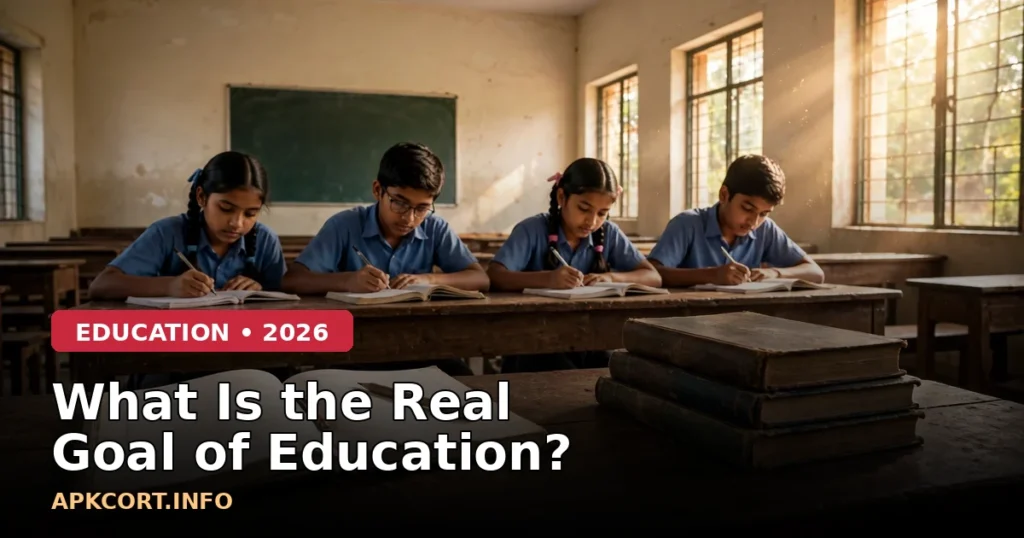
Quick question. If a student scores 98% in Class 12 and then cannot write a simple job application letter, has education succeeded or failed?
Most of India would say the student succeeded. I disagree. And I think deep down, you disagree too.
We have turned education into a scoreboard. JEE ranks. NEET cutoffs. Board percentages. Kota coaching fees of ₹1.5 to ₹2 lakh a year for teenagers who barely sleep. But somewhere in this race, we stopped asking the most basic question: what is education actually for? What is the real goal of education?
This piece is my honest answer. You are free to argue with it.
The Question Nobody in the Race Asks
Picture this. A 16-year-old in Kota wakes up at 6 AM, attends coaching till evening, studies till midnight, and repeats. His parents have spent over ₹3 lakh so far. He knows the formula for projectile motion by heart. Ask him what he wants to do with his life, and he goes blank.
This is not a rare story. It is the default story. Roughly 14 lakh students appeared for JEE Main in recent years, fighting for about 17,000 IIT seats. That is a success rate of barely 1.2%. NEET draws over 25 lakh aspirants for roughly 1.1 lakh MBBS seats. We built an entire industry around the 1%, and we call the anxiety it produces "healthy competition."
So let me ask again, slower this time: if the goal of education is marks, what happens to the 99% who do not top? Were their twelve years of schooling a waste?
Marks Are a Receipt, Not the Product
Think of marks like a bill from a restaurant. The bill tells you something was consumed, but it tells you nothing about whether the food was good. A 95% is a receipt. It proves the student memorised well enough to clear a three-hour exam. It proves nothing about what they can build, decide, or earn.
I am not saying marks are useless. They open doors. A good board percentage gets you into a good college, and a good college gets you into the interview room. But here is the honest part nobody in a coaching ad will say: the interview room is where memorisation stops working. The interviewer does not ask for definitions. She asks, "Tell me how you would solve this." And that is a completely different muscle.
The real goal of education is not the receipt. It is the product: a person who can think, earn, and behave like a decent human being.
The Real Goal of Education: Three Pillars
If I had to rebuild the goal of education from scratch, I would set three targets. Everything else, subjects, syllabi, exams, should serve these three.
Pillar 1: The Ability to Think Clearly
Critical thinking is the least taught and most needed skill in Indian classrooms. Most of our exams reward the student who reproduces the textbook answer fastest. The student who questions the textbook answer gets marks deducted.
But adult life is one long open-book exam with no answer key. Should you take this job or that one? Is this investment scheme genuine or a scam? Is this WhatsApp forward true or fake? Nobody hands you a marking scheme for these.
Education should train the habit of asking: what is the evidence, what is the other side, what am I missing? That habit is worth more than any single subject. It is also what makes a citizen harder to fool, which might be exactly why our system underinvests in it. If you want to see how classrooms themselves are changing toward more interactive learning, read how technology improves classroom teaching.
Pillar 2: The Ability to Earn a Living
Let us be blunt. For most Indian families, education is an investment, and investments are judged by returns. A degree that does not help you earn is a luxury most families cannot afford.
This is where our system quietly fails millions. India produces lakhs of graduates every year, yet employers keep saying the same thing: graduates are not job-ready. Degrees in hand, skills missing. The gap between what colleges teach and what workplaces need is one of the biggest open secrets in Indian education.
The goal of education must include practical earning ability. Can the student use a computer properly? Can they write, communicate, and solve real problems? Even basic computer skills every student must learn make an enormous difference in employability, and they are not rocket science. A graduate who can actually do things will always beat a topper who can only describe them.
Pillar 3: The Character to Deserve Success
Here is the pillar nobody talks about because it cannot be measured in an exam. What is the point of producing a brilliant engineer who cheats clients? A sharp doctor who overcharges patients? A topper who cannot work in a team?
Character sounds old-fashioned. It is not. It is the operating system on which thinking and earning run. Honesty, discipline, empathy, the willingness to admit mistakes, these decide whether a skilled person becomes an asset or a liability. A school that produces a 99% scorer who bullies juniors has failed at education, whatever its result sheet says.
For a deeper look at the bigger picture behind these ideas, the philosophy of education explained covers how thinkers through history defined what learning is really for.
The Goal of Education vs. Indian Reality
Now the uncomfortable part. If these three pillars are the real goal of education, how is India doing?
Mixed, honestly. The NEP 2020 (National Education Policy) talks about exactly the right things: critical thinking, vocational skills, mother-tongue learning, less rote memorisation, multiple entry and exit options in college. On paper, it is the best education policy India has written. On the ground, implementation is slow, uneven, and tangled in state politics. The CBSE and ICSE boards have started adding competency-based questions, which is a genuine step toward testing understanding instead of memory.
The coaching industry is the other reality. It is a multi-thousand-crore machine that profits from parental anxiety. Kota alone hosts over 2 lakh students a year. The pressure has a dark side that we must name: India loses thousands of students to suicide every year, with exam and career pressure repeatedly cited among the causes. Any system that produces toppers and corpses at the same time needs honest reform, not celebration.
And then there is the jobs reality. Government job aspirants number in crores. The UPSC civil services exam draws around 11 lakh applicants for roughly 1,000 posts. That is not a career plan for most people, it is a lottery ticket with a syllabus. Education should prepare students for the 99 real paths, not just the 1 glamorous one.
So What Should a Student Actually Do?
Enough diagnosis. If you are a student or a parent reading this, here is practical advice that respects the system as it is while aiming at the real goal.
Study for understanding, revise for marks. You need both. Understand the concept deeply, then practise the exam format. The first builds your brain, the second gets you through the door. Do not let anyone tell you it is either-or.
Build one real skill alongside your syllabus. Coding, writing, design, video editing, spoken English, accounting basics. Pick one and get genuinely good. This is your backup plan and often becomes your main plan. Your degree gets you shortlisted; your skill gets you hired.
Learn how money works before you need it. Most Indian students leave college without understanding salary slips, taxes, or savings. That is an education failure, plain and simple. Read one good book on personal finance before you turn 22. It will pay for itself a thousand times.
Protect your curiosity. The system will try to flatten it into a timetable. Read things that are not in your syllabus. Ask why. Argue respectfully with teachers who allow it. Curiosity is the engine; marks are just the speedometer.
Choose your race deliberately. Not everyone needs to run the JEE-NEET-UPSC marathon. There are real, respected careers in design, trades, content, sports, defence, entrepreneurship, and skilled services. A deliberate choice beats a default one every time.
For the broader case on why learning matters at all in a changing economy, why education is important lays out the argument in full.
<h2>Questions People Actually Ask</h2>
What is the main goal of education?
The main goal of education is to develop a person’s ability to think clearly, earn a living, and live as a responsible member of society. Marks and degrees are milestones along the way, not the destination. An educated person should be able to solve real problems, adapt to change, and make decisions based on evidence rather than habit.
Why does the Indian education system focus so much on marks?
Because marks are easy to measure and easy to compare. In a country with 14 lakh JEE aspirants and limited seats, exams became the filtering tool, and filtering tools became the goal. Coaching industries, parental pressure, and social prestige then locked the pattern in place. It is a system optimised for selection, not for learning.
What does NEP 2020 change about the goal of education?
NEP 2020 officially shifts the stated goal from rote learning to critical thinking, creativity, and vocational skills. It proposes competency-based assessment, flexible subject choices, and multiple entry-exit options in higher education. The direction is right; the challenge is implementation across thousands of schools with very different resources.
Can you succeed in India without top marks?
Yes, and millions do. Employers increasingly test skills, portfolios, and problem-solving rather than percentages. Fields like technology, design, content creation, skilled trades, and entrepreneurship reward demonstrated ability over mark sheets. Marks help at the entry gate, but after your first job, almost nobody asks about them.
How can parents support the real goal of education?
Stop treating every test as a verdict on your child’s worth. Encourage questions more than answers. Let children try skills outside the syllabus without demanding instant results. And watch for the warning signs of burnout: sleep loss, loss of appetite, withdrawal, or constant fear of disappointing you. No rank is worth a child’s mental health.