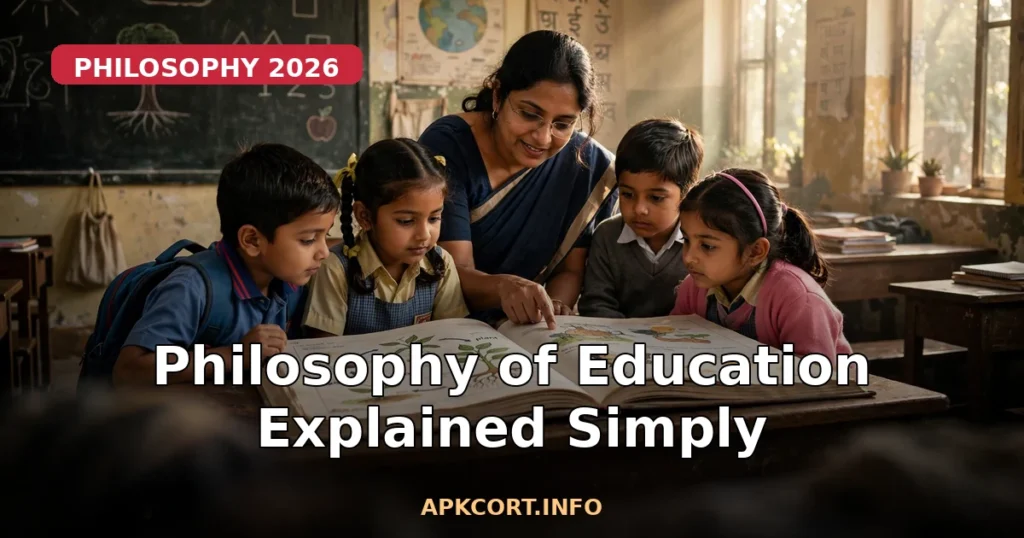
Walk into two classrooms in the same city. In the first, the teacher speaks for forty minutes while thirty students copy notes in pin-drop silence. In the second, students work in noisy groups, building a working model of a water filter, arguing, laughing, making a glorious mess. Both teachers are fully convinced their way is correct.
Here is the secret neither of them will tell you: both are following a philosophy of education, whether they know the word or not.
Philosophy sounds like something old men debate over chai. But in education, it simply means the big beliefs hiding behind everyday teaching. Why do we teach this subject and not that one? Should children memorize or discover? Is school meant to preserve tradition or change society? Every school answers these questions daily through its timetable, its exams, and its punishments.
This guide explains the four big schools of thought in plain language, with Indian classroom examples you will actually recognize. If you are already convinced about why education matters in 2026, consider this the perfect follow-up: it reveals the thinking that runs the whole system.
What "philosophy of education" actually means
Strip away the heavy word and the idea is almost embarrassingly simple. A philosophy of education is a school's answer to three questions:
- What should children learn?
- How should they learn it?
- What is school actually for?
That is the whole game. Everything else is decoration. A school that drills multiplication tables has answered: learn the basics, by repetition, to build a strong foundation. A school that sends students to clean a nearby pond has answered: learn responsibility, by doing real work, to improve society. Neither school sat down and wrote a philosophy document. But both are living one.
Thinkers have grouped these answers into four big schools of thought. The names sound Greek and intimidating. The ideas are things you have watched happen in real classrooms. These ideas also connect directly to the goal of education, because what you believe school is for decides every smaller choice a teacher makes.
Perennialism: some truths never expire
Perennialism says certain ideas are timeless, so teach them. The great books. Classic literature. Moral values. The distilled wisdom of the past. Fashions change, governments change, apps change. Truth does not. In a perennialist classroom, the teacher is the authority, the curriculum is the classics, and the student's job is to absorb the best of what humanity figured out long ago.
You have seen this all over India. The morning assembly where students recite shlokas together. The moral science period built around stories from the Ramayana and Mahabharata. The old gurukul tradition, where the guru passed texts down exactly as received, word for word. Even today, when a school insists every child learn the freedom struggle in full detail, that is perennialism at work: some stories must never be allowed to fade.
The strength is obvious. Children get roots. They know who they are and where they come from. A kid who has heard the story of Bhagat Singh or Rani Lakshmibai carries something no app can install.
The weakness is equally real. It can decay into memorizing old things while the world outside sprints ahead. A student who can recite the entire periodic table but cannot operate a computer has roots but no wings. Tradition is a foundation, not a finished house.
Essentialism: master the basics, everything else follows
Essentialism is the stricter elder sibling of perennialism. It says there is a core body of knowledge every educated person must possess. Reading, writing, arithmetic, science, history. Teach it properly. Test it seriously. No shortcuts, no excuses. The teacher leads, the student practices, discipline matters.
This is the philosophy running most Indian board-exam classrooms right now. The NCERT textbook is treated like scripture. The Class 10 board exam in Patna and the Class 12 exam in Chennai decide futures, so the entire system bends toward mastering the essentials. Coaching centers are essentialism in its purest commercial form: identify the syllabus, drill it, test it, repeat until the marks arrive.
Honestly, there is plenty to respect here. A child who cannot read, write, or do basic arithmetic is locked out of everything else in life. And the list of "essentials" keeps growing. In 2026, basic computer skills belong in the core: typing, email, spreadsheets, staying safe online. If you want the full argument, read about the importance of computer education in today's India. A school that still treats computers as optional is preparing children for 1996, not 2026.
The risk? Essentialism can squeeze curiosity to death. When marks are the only goal, students learn how to pass, not how to think. The topper who freezes when asked an out-of-syllabus question is essentialism's warning sign.
Progressivism: stop memorizing, start doing
Progressivism flips the classroom on its head. Children learn best by doing, it says, not by listening. Run experiments. Build models. Ask uncomfortable questions. Make mistakes and learn from them. The teacher stops being a lecturer and becomes a guide. The student's curiosity drives the lesson, not the textbook's chapter order.
Indian examples are everywhere once you start looking. The school science exhibition where a Class 8 student explains her working rainwater harvesting model to visitors. The field trip to a nearby farm to understand crops instead of reading one dull paragraph about them. The rare teacher who lets students debate whether homework should exist, and genuinely listens to the answers.
India's most famous version of this idea came from Mahatma Gandhi himself. His Nai Talim, the Basic Education scheme of 1937, declared that children should learn through productive craft: spinning, weaving, gardening. Head, heart, and hands working together. A child spinning khadi was learning economics, physics, and self-reliance in a single activity. That is progressivism with an Indian soul, decades before the word became fashionable at education conferences.
Technology has handed progressivism powerful new tools. Smart boards, educational videos, virtual science labs. A good teacher today can show a volcano erupting in 3D instead of merely describing one. See how technology improves classroom teaching for a clear picture of this shift in action.
But here is the honest catch. Progressivism demands good teachers and decent resources. In an overcrowded classroom with one exhausted teacher and forty-five restless kids, "learning by doing" can quietly decay into doing not much at all. The philosophy is only as good as its execution.
Reconstructivism: school should repair the world
The boldest of the four. Reconstructivism says education is not only about the child and not only about the past. It is about fixing society. Schools should train students to spot what is broken, caste discrimination, gender inequality, pollution, corruption, and hand them the tools to change it.
In India, you can spot flashes of this philosophy in the best school programs. Students organizing a cleanliness drive after their Swachh Bharat lesson. A classroom discussion on why girls in the village drop out after Class 8, followed by the students themselves campaigning for Beti Bachao, Beti Padhao. An eco-club planting trees and auditing the school's plastic waste. The real lesson is not in the textbook. The lesson is the village itself, and the homework is to improve it.
The strength is obvious: it produces citizens with opinions, not only mark sheets. The criticism is fair too: whose vision of a "better society" gets taught? A reconstructivist classroom needs a teacher mature enough to let students disagree, even with the teacher. Without that honesty, it becomes propaganda with better lighting.
India had its own philosophers of education first
Long before these Western labels reached our textbooks, Indian thinkers had built complete philosophies of schooling.
Rabindranath Tagore founded Shantiniketan in 1901 because he despised the rigid, prison-like schools of British India. His idea: children should learn in nature, under trees, with music, art, and freedom woven into every single day. Education, for Tagore, meant growing a complete human being, not manufacturing a clerk. His school grew into Visva-Bharati University. Walk through Shantiniketan even today and you can feel the philosophy in its open-air classrooms.
Gandhi's Nai Talim, which we met earlier, made craft the center of learning and dignified manual work at a time when the system looked down on it. In a country that still undervalues skilled hands, that idea remains quietly radical.
The point is simple: you do not need Greek names to have a philosophy of education. India has been arguing about "what is school for" for over a century. NEP 2020, with its push for mother tongue instruction, arts, sports, and vocational skills from an early age, is arguably India catching up to what Tagore and Gandhi said decades ago.
Which philosophy of education runs your school? A quick self-check
Read the four sketches below and notice which one feels most familiar. Most real schools are a mix, with one philosophy quietly dominating.
- The day begins with prayers, shlokas, or moral stories, and old texts are treated with deep respect. Toppers are the ones who know the tradition best. That is perennialism.
- The timetable worships the board syllabus, tests arrive every month, and "finish the NCERT first" is the house rule. That is essentialism.
- Teachers assign projects, organize field visits, and the highest praise goes to the most creative work rather than the neatest notebook. That is progressivism.
- The school runs cleanliness drives, debates social issues in class, and expects students to improve their neighborhood, not just their grades. That is reconstructivism.
No law says a school must pick exactly one. The finest teachers I have observed steal from all four: the discipline of essentialism, the roots of perennialism, the energy of progressivism, and the purpose of reconstructivism.
<h2>Questions People Actually Ask</h2>
What are the four main philosophies of education? Perennialism, essentialism, progressivism, and reconstructivism. In one line each: teach timeless truths; master the core basics; learn by doing; use school to fix society. Most real classrooms blend at least two of them.
### Which philosophy of education is best for Indian schools?
None wins outright, and anyone selling you one true method is selling coaching, not wisdom. NEP 2020 leans toward progressivism with its focus on activity-based learning and vocational skills, but board exams keep essentialism firmly in charge. A healthy mix matched to the child’s age works better than any single label.
What is the difference between perennialism and essentialism? Both are traditional and teacher-led, which is why people confuse them. Perennialism centers on eternal truths and classic texts, the great books and moral wisdom of the past. Essentialism centers on core skills and subjects, the reading, writing, and math every student must master and be tested on. Think: timeless wisdom versus testable basics.
### Did Mahatma Gandhi really have a philosophy of education?
Yes, and a detailed one. His Nai Talim (Basic Education, 1937) proposed craft-centered schooling where children learn through productive work like spinning, weaving, and gardening. Education had to build character, teach self-reliance, and dignify manual labor. It was progressivism shaped entirely by Indian realities.